

You know how to say “Xiao Li closed the door.” Now you want to start from the door, the bag, or the cup, and say what happened to it. Chinese often uses 被 (bèi) when the receiver of the action is the topic of the sentence.
The useful question is: What happened to this person or thing? Start with the affected person or object, then say who did it, if that matters, and what the result was.
This lesson is a practical guide to 被 sentences for everyday situations. You will also learn why an English passive does not automatically become a natural 被 sentence in Chinese.
Table of Contents
The basic pattern
Receiver + 被 + agent + verb + additional information
门被小李关上了。
Mén bèi Xiǎo Lǐ guān shàng le.
The door was closed by Xiao Li.
- 门 identifies the thing that was affected, and it is the topic.
- 小李 identifies the person who closed it.
- 关上了 tells us that the door ended up closed.
Compare the same event with a 把 sentence:
小李把门关上了。
Xiǎo Lǐ bǎ mén guān shàng le.
Xiao Li closed the door.
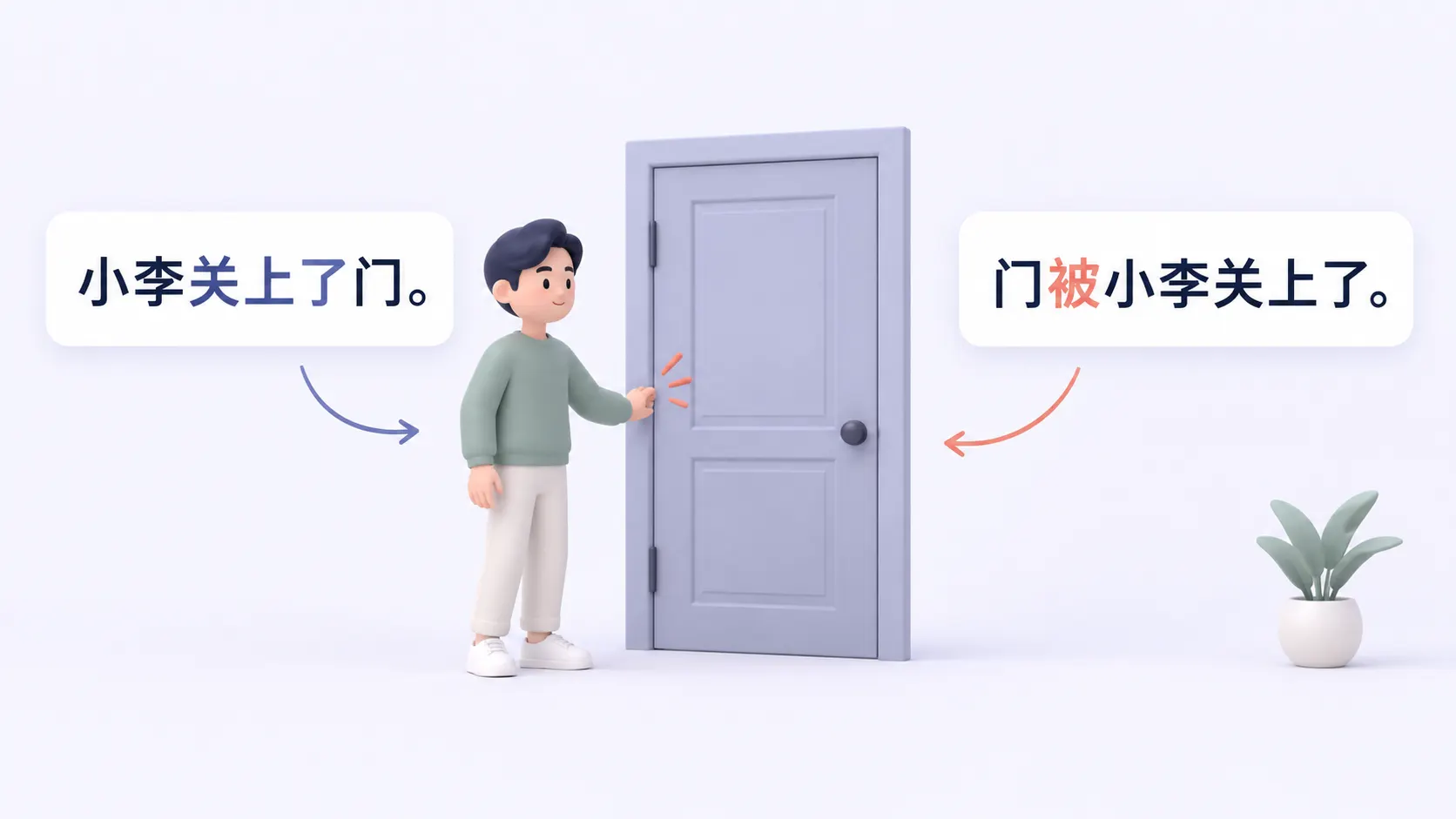
把 starts from the person and what they do to a known object. 被 starts from the person or thing that is affected. The event can be the same; the starting point is different.
When Chinese uses 被 — and when it does not
English uses the passive very often. Chinese does not. If you simply want to say who did something, a natural active sentence is usually better:
小李关了门。
Xiǎo Lǐ guān le mén.
Xiao Li closed the door.
Use 被 when the receiver is what you are talking about, and you want to say what happened to it. That is common when:
- the agent is unknown, obvious, or not important
- something unexpected, inconvenient, or otherwise noteworthy happened to the receiver
- you are starting from a person or object already in the conversation, such as my bag or the window
我的钱包被偷了。
Wǒ de qiánbāo bèi tōu le.
My wallet was stolen.包被拿走了。
Bāo bèi ná zǒu le.
The bag was taken away.我被雨淋湿了。
Wǒ bèi yǔ lín shī le.
I got soaked by the rain.
被 is useful in these situations, but it is not a default translation of every English sentence with was or got. For the wider word order around these sentences, see Chinese sentence structure.
The agent is often optional
If the agent is unknown, obvious, or unimportant, you can leave it out:
Receiver + 被 + verb + additional information
杯子被打破了。
Bēizi bèi dǎ pò le.
The cup was broken.门被关上了。
Mén bèi guān shàng le.
The door was closed.我被骗了。
Wǒ bèi piàn le.
I was tricked.
Add the agent when it matters:
杯子被弟弟打破了。
Bēizi bèi dìdi dǎ pò le.
The cup was broken by my little brother.
If you want the focus on what your brother did, use a 把 sentence or an ordinary active sentence instead: 弟弟把杯子打破了。
Complete the verb with a result
Like 把 sentences, 被 sentences usually need more than a bare verb. A result, direction, or another clear ending often completes the meaning:
| Verb phrase | Pinyin | Result |
|---|---|---|
| 关上 | guān shàng | close (and it ends up closed) |
| 打破 | dǎ pò | hit or drop something so that it breaks |
| 拿走 | ná zǒu | take away |
| 淋湿 | lín shī | get soaked |
| 看完 | kàn wán | finish reading or watching |
窗户被风吹开了。
Chuānghu bèi fēng chuī kāi le.
The window was blown open by the wind.那本书被他看完了。
Nà běn shū bèi tā kàn wán le.
That book was finished by him.手机被她拿走了。
Shǒujī bèi tā ná zǒu le.
The phone was taken away by her.
门被关 leaves the listener waiting for more information in this pattern, just as 把门关 often does. Decide what actually happened to the door: 门被关上了。
Put 没 before 被 when the event or result has not happened. Review negation in Chinese if you want more practice with 没 and 不.
钱包没被偷。
Qiánbāo méi bèi tōu.
The wallet was not stolen.门还没被关上。
Mén hái méi bèi guān shàng.
The door has not been closed yet.
被 is not only for bad news

Many early examples are inconvenient or unexpected, because that is a common reason to start from the receiver. 被 can also report a positive or neutral result:
他被老师表扬了。
Tā bèi lǎoshī biǎoyáng le.
He was praised by the teacher.她被选中了。
Tā bèi xuǎn zhòng le.
She was selected.
The image compares a broken cup with a person being praised. The grammar pattern is the same; the result is what changes the tone of the sentence.
How 被 compares with 把
把 and 被 can describe the same event from opposite sides:
| Focus | Sentence | Pinyin | Meaning |
|---|---|---|---|
| What the agent does to a known object | 小李把门关上了。 | Xiǎo Lǐ bǎ mén guān shàng le. | Xiao Li closed the door. |
| What happens to the receiver | 门被小李关上了。 | Mén bèi Xiǎo Lǐ guān shàng le. | The door was closed by Xiao Li. |
Do not treat one structure as a mechanical conversion of the other. Choose 把 when you are managing or disposing of a particular object. Choose 被 when the affected person or thing is the starting point. For object, result, and destination practice, use the lesson on 把 sentences.
Three common mistakes
1. Translating every English passive with 被
English “This book was written by her” is often more natural as:
这本书是她写的。
Zhè běn shū shì tā xiě de.
This book was written by her. / This is a book she wrote.
Do not change it to 这本书被她写了. Likewise, “I was born in Shanghai” is 我出生在上海, not a 被 sentence. Use 被 when something is done to the receiver, not as a label for every English passive.
2. Ending with an unsupported bare verb
Instead of 门被关, say what happened to the door:
门被关上了。
Mén bèi guān shàng le.
The door was closed.
3. Mixing up 把 and 被
If you mean “I closed the door,” keep yourself as the agent:
我把门关上了。
Wǒ bǎ mén guān shàng le.
I closed the door.
If the door is the topic, the door comes first:
门被我关上了。
Mén bèi wǒ guān shàng le.
The door was closed by me.
我被门关上了 would mean that you were closed by the door, which is not the intended meaning.
A short dialogue: A window and a cup
A: 窗户怎么开了?
Chuānghu zěnme kāi le?
How did the window get open?
B: 窗户被风吹开了。
Chuānghu bèi fēng chuī kāi le.
The window was blown open by the wind.
A: 请把它关上。
Qǐng bǎ tā guān shàng.
Please close it.
B: 好。对了,杯子被弟弟打破了。
Hǎo. Duìle, bēizi bèi dìdi dǎ pò le.
Okay. By the way, the cup was broken by my little brother.
A: 他被妈妈批评了吗?
Tā bèi māma pīpíng le ma?
Was he criticized by Mom?
B: 还没有。
Hái méiyǒu.
Not yet.
The dialogue uses both structures in one situation: 被 reports what happened to the window and the cup, and 把 is used for the request to close the window.
Practice
- Arrange: 门 / 被 / 关上了 / 小李.
- Translate: “My wallet was stolen.”
- Add 没 in the correct position: 包被拿走。
- Change this into a 被 sentence: 弟弟打破了杯子。
- Correct this sentence so that it means “I closed the door”: 我被门关上了。
- Which sentence is more natural for “This book was written by her”: 这本书被她写了。 or 这本书是她写的。?
- Does 他被老师表扬了 describe something bad?
Answers
- 门被小李关上了。 — Mén bèi Xiǎo Lǐ guān shàng le.
- 我的钱包被偷了。 — Wǒ de qiánbāo bèi tōu le.
- 包没被拿走。 — Bāo méi bèi ná zǒu. The bag was not taken away.
- 杯子被弟弟打破了。 — Bēizi bèi dìdi dǎ pò le.
- 我把门关上了。 — Wǒ bǎ mén guān shàng le. If the door is the topic, 门被我关上了 is also possible.
- 这本书是她写的。 The 被 version is not the usual way to say this.
- No. It means “He was praised by the teacher.”
Frequently asked questions
Does 被 mean “by”?
被 is a grammatical marker that introduces a passive event. The agent, when it is mentioned, comes after 被, and English often translates that part with “by.” Translating every 被 as “by” hides the verb and the result, which carry the main meaning.
Is a 被 sentence just the opposite of a 把 sentence?
They can describe the same event from different sides, but they are not mechanical opposites. 把 keeps the agent as the subject and places a known object before the verb. 被 makes the receiver the subject. For a fuller comparison, see 把 sentences and the more advanced notes in Advanced Chinese Sentence Structures.
Must I include the agent after 被?
No. 杯子被打破了 is complete when you do not need to say who did it. Add the agent when that information matters.
Is 被 always negative?
No. Many textbook examples are inconvenient or unexpected, but 他被老师表扬了 and 她被选中了 are positive uses of the same pattern.
Can I turn every English passive into a 被 sentence?
No. First ask whether the receiver is really the topic, and whether something was done to it. Ordinary active sentences, 把 sentences, and patterns such as 是……的 are often more natural.
For broader practice, revisit Chinese sentence structure, then describe three real situations: a missing bag, a window that blew open, and a person who was praised.
被 Sentences: Key Points
- The basic pattern is receiver + 被 + (agent) + verb + additional information.
- Use 被 when the affected person or thing is the topic, not as a default translation of every English passive.
- The agent after 被 is optional when it is unknown, obvious, or unimportant.
- Complete the verb with a result, direction, or other clear ending: 关上, 打破, 拿走, 淋湿.
- Put 没 before 被: 门还没被关上。
- 被 is not only for bad news; 被表扬 and 被选中 use the same pattern.
- 把 starts from what someone does to a known object; 被 starts from what happens to the receiver.
Keep learning: Explore the Chinese Grammar Guide and the Learn Chinese Blog for related lessons.