
Chinese Result Complements: 看懂, 听见, 做完, and More
Listening does not guarantee hearing, reading does not guarantee understanding, and doing a task does not guarantee finishing it. Chinese can make these differences explicit by placing a result complement after the action verb.
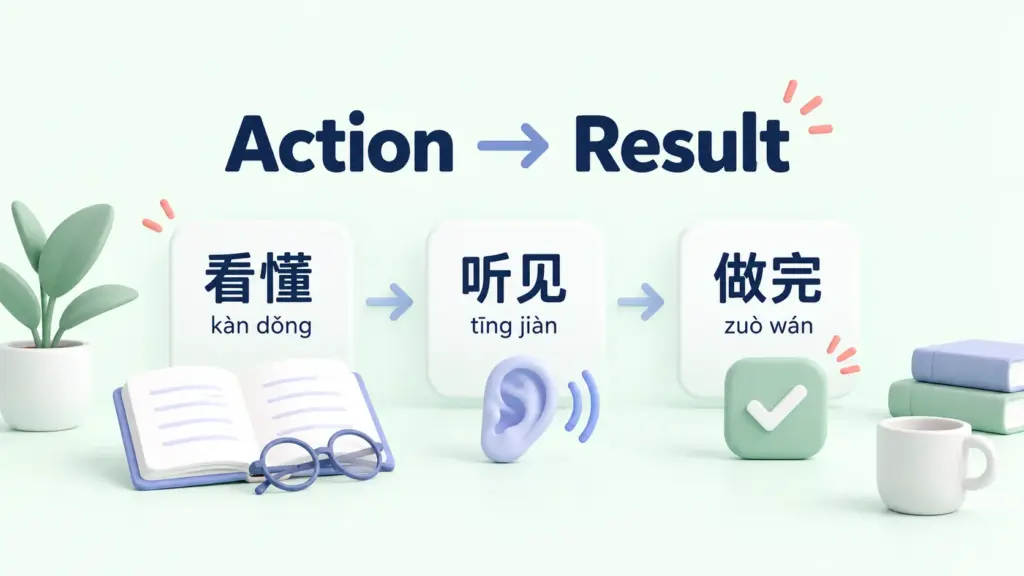
Start with useful combinations rather than trying to attach every possible result to every verb. 看懂 (kàn dǒng), 听见 (tīng jiàn), and 做完 (zuò wán) describe outcomes you can use immediately.
Action plus outcome
Verb + result complement + object
我看懂了这句话。
Wǒ kàn dǒng le zhè jù huà.
I understood this sentence when I read it.
Compare 我看了这句话: “I read this sentence.” That version reports the action, without saying whether the meaning became clear.
The complement follows the verb directly. Do not put the object between 看 and 懂. DigMandarin’s result-complement reference introduces this verb-plus-result structure and its common negative form.
| Combination | Pinyin | Outcome |
|---|---|---|
| 看懂 | kàn dǒng | understand by reading or watching |
| 听懂 | tīng dǒng | understand by listening |
| 听见 | tīng jiàn | hear a sound |
| 找到 | zhǎo dào | find what you looked for |
| 做完 | zuò wán | finish doing |
| 写错 | xiě cuò | write incorrectly |
| 洗干净 | xǐ gānjìng | wash clean |
| 学会 | xué huì | learn how to do something |
A complement is not always one character. 干净 is a two-syllable word describing the clean result.
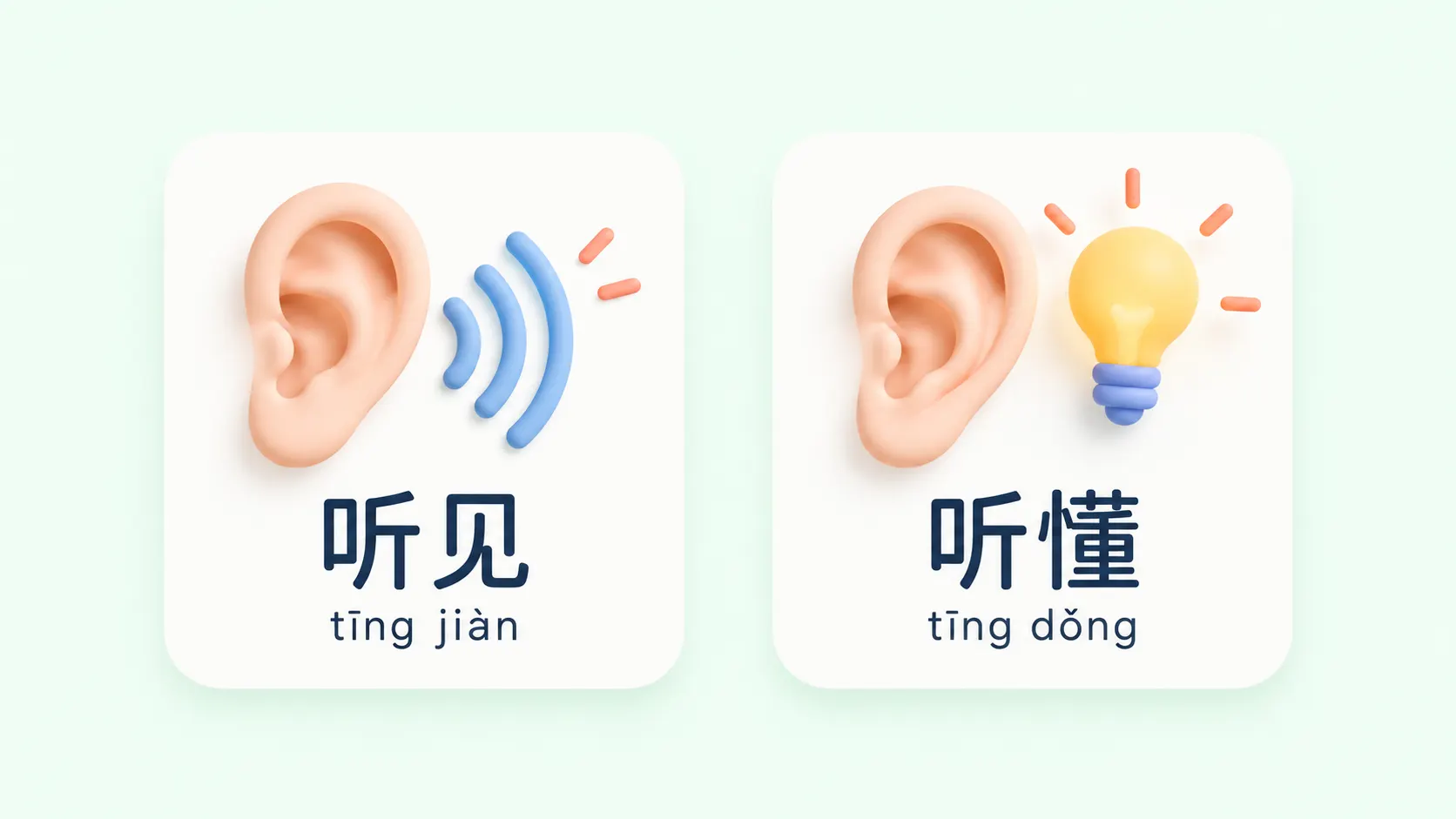
听见 versus 听懂
我听见了你的声音。
Wǒ tīng jiàn le nǐ de shēngyīn.
I heard your voice.我听懂了你的意思。
Wǒ tīng dǒng le nǐ de yìsi.
I understood what you meant.
You can hear someone clearly without understanding the language. Conversely, if the connection cuts out, the problem may be hearing rather than vocabulary.
我听见了,但是没听懂。
Wǒ tīng jiàn le, dànshì méi tīng dǒng.
I heard it, but I didn’t understand it.
This is a useful sentence in class. It tells the teacher that repeating at the same volume may not solve the problem.
完 says the activity reaches its endpoint
我做完作业了。
Wǒ zuò wán zuòyè le.
I have finished my homework.她看完那封邮件了。
Tā kàn wán nà fēng yóujiàn le.
She has finished reading that email.我们吃完饭再走。
Wǒmen chī wán fàn zài zǒu.
We’ll leave after we finish eating.
The last example discusses a sequence of actions. 完 still means finishing, even without 了. The complement gives the outcome; 了 has a separate grammatical role.
Do not translate 做完 as “do well.” Completion and quality are different. A finished exercise may still contain mistakes.
没 denies that the result happened
没 / 没有 + verb + result complement
我没找到钥匙。
Wǒ méi zhǎo dào yàoshi.
I didn’t find the keys.他没听懂这个问题。
Tā méi tīng dǒng zhège wèntí.
He didn’t understand this question.我还没做完。
Wǒ hái méi zuò wán.
I haven’t finished yet.
These sentences need not deny the attempt. 没找到 can mean that you looked but did not find what you wanted.
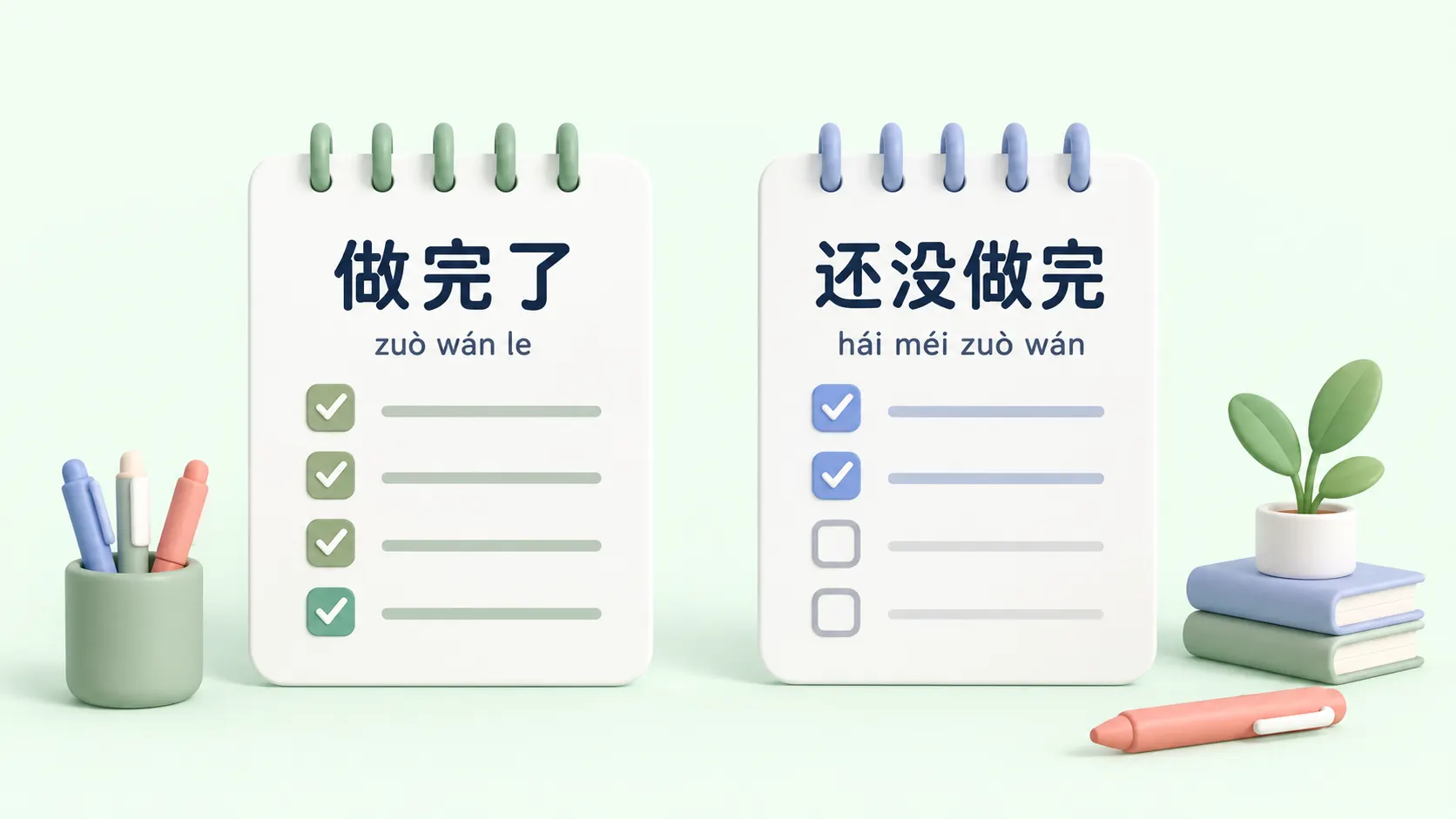
For this basic negative pattern, do not retain a completion 了 mechanically. Learn 做完了 / 没做完 as a useful pair.
A failed result is different from inability
Compare:
我没看懂。
Wǒ méi kàn dǒng.
I didn’t understand what I read.我看不懂。
Wǒ kàn bu dǒng.
I can’t understand it when I read it.
The first describes an outcome that did not occur. The second uses 不 between the verb and complement to express a potential limitation. Its positive counterpart is 看得懂 (kàn de dǒng).
This lesson focuses on actual results. Keep potential complements as a separate pattern instead of treating 没看懂 and 看不懂 as identical.
Ask about the result you care about
你找到钥匙了吗?
Nǐ zhǎo dào yàoshi le ma?
Did you find the keys?你听懂了吗?
Nǐ tīng dǒng le ma?
Did you understand?你做完了吗?
Nǐ zuò wán le ma?
Have you finished?
Answer with the relevant verb phrase:
- 找到了。 (Zhǎo dào le.) Found them.
- 听懂了。 (Tīng dǒng le.) Understood.
- 还没做完。 (Hái méi zuò wán.) Not finished yet.
A general 是 response is often less informative than repeating the action and result.
A classroom conversation
A: 这句话你看懂了吗?
Zhè jù huà nǐ kàn dǒng le ma?
Did you understand this sentence?
B: 前半句看懂了,后半句没看懂。
Qián bàn jù kàn dǒng le, hòu bàn jù méi kàn dǒng.
I understood the first half, but not the second half.
A: 我解释一下。
Wǒ jiěshì yíxià.
Let me explain.
B: 谢谢,现在懂了。
Xièxie, xiànzài dǒng le.
Thanks, I understand now.
The learner identifies the exact problem. That is more useful than saying “I don’t know Chinese.”
Common mistakes to catch
Separating the verb and complement: Use 听懂这个问题, not 听这个问题懂.
Confusing hearing with understanding: Choose 听见 for sound reaching you and 听懂 for grasping meaning.
Adding 完 to every success: Finding keys is 找到, not automatically 找完. The complement must fit the intended result.
Calling 了 the result word: In 看懂了, 懂 supplies “understand.” Removing it changes what the sentence says.
Practice
- Choose 听见 or 听懂 for hearing a doorbell.
- Translate “I didn’t find my phone.”
- Make 做完了 negative.
- Does 没听懂 prove that the person was not listening?
- Correct 我看这句话懂了.
- Which expresses inability: 没看懂 or 看不懂?
Answers
- 听见 (tīng jiàn).
- 我没找到手机。 (Wǒ méi zhǎo dào shǒujī.)
- 没做完。 (Méi zuò wán.)
- No. Listening may have occurred without understanding.
- 我看懂这句话了。 (Wǒ kàn dǒng zhè jù huà le.)
- 看不懂 (kàn bu dǒng).
Frequently asked questions
Does every result complement describe success?
No. 写错 means an incorrect result, and 打破 means breaking something.
Is 完 the same as 了?
No. 完 expresses an endpoint. 了 has aspectual or sentence-level functions depending on its position.
Can a result complement refer to the future?
Yes. A plan such as 吃完饭再走 includes a result that has not happened yet.
Should I memorize isolated complements?
Learn productive pairs with real situations first. “Look for → find” and “read → understand” make the meanings easier to remember.
After your next study session, say what you did, what you finished, and what you understood. Those are three different pieces of information.
Chinese Result Complements: Key Points
Keep learning: Explore Chinese Grammar Guide and Chinese Vocabulary Hub for related lessons.