
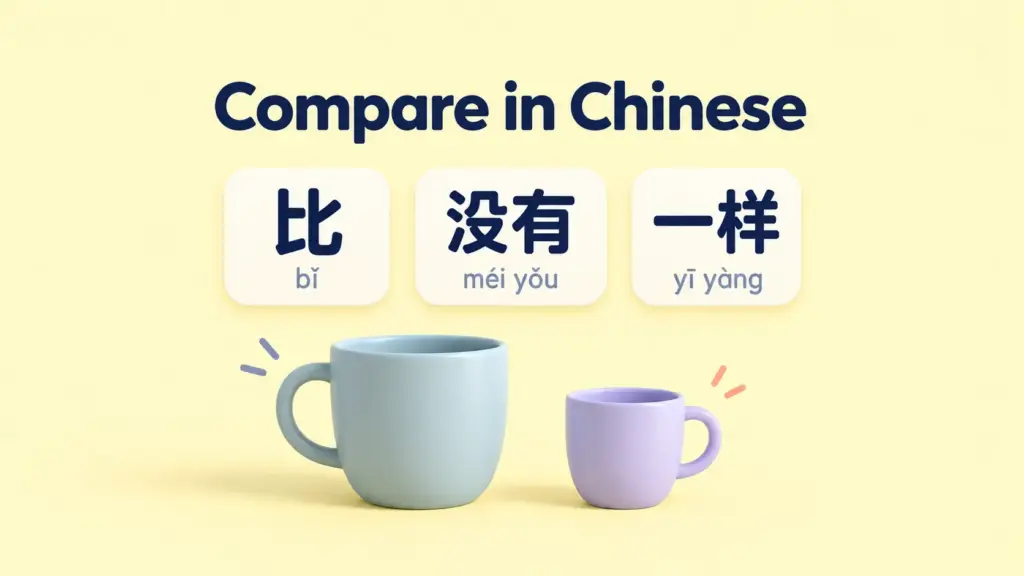
Comparisons in Chinese: 比, 没有, and 一样
You are choosing between two bags. One costs 80 yuan and the other costs 100. Saying “cheap” is useful, but saying “this one is cheaper” lets you explain a choice.
Chinese has three especially useful comparison patterns: 比 (bǐ) for a difference, 没有 (méiyǒu) for “not as,” and 一样 (yíyàng) for equality. Keep the things being compared in clear positions and let the adjective name the quality.
More or less with 比
A + 比 + B + adjective
这个包比那个包便宜。
Zhège bāo bǐ nàge bāo piányi.
This bag is cheaper than that one.今天比昨天冷。
Jīntiān bǐ zuótiān lěng.
Today is colder than yesterday.我姐姐比我高。
Wǒ jiějie bǐ wǒ gāo.
My older sister is taller than me.
The adjective does not change its form. 高 can mean “tall” in a description and “taller” in this comparison pattern.
Do not add 是 before the adjective or 很 simply because you have learned sentences such as 她很高. The basic comparison is 她比我高, not 她比我很高.
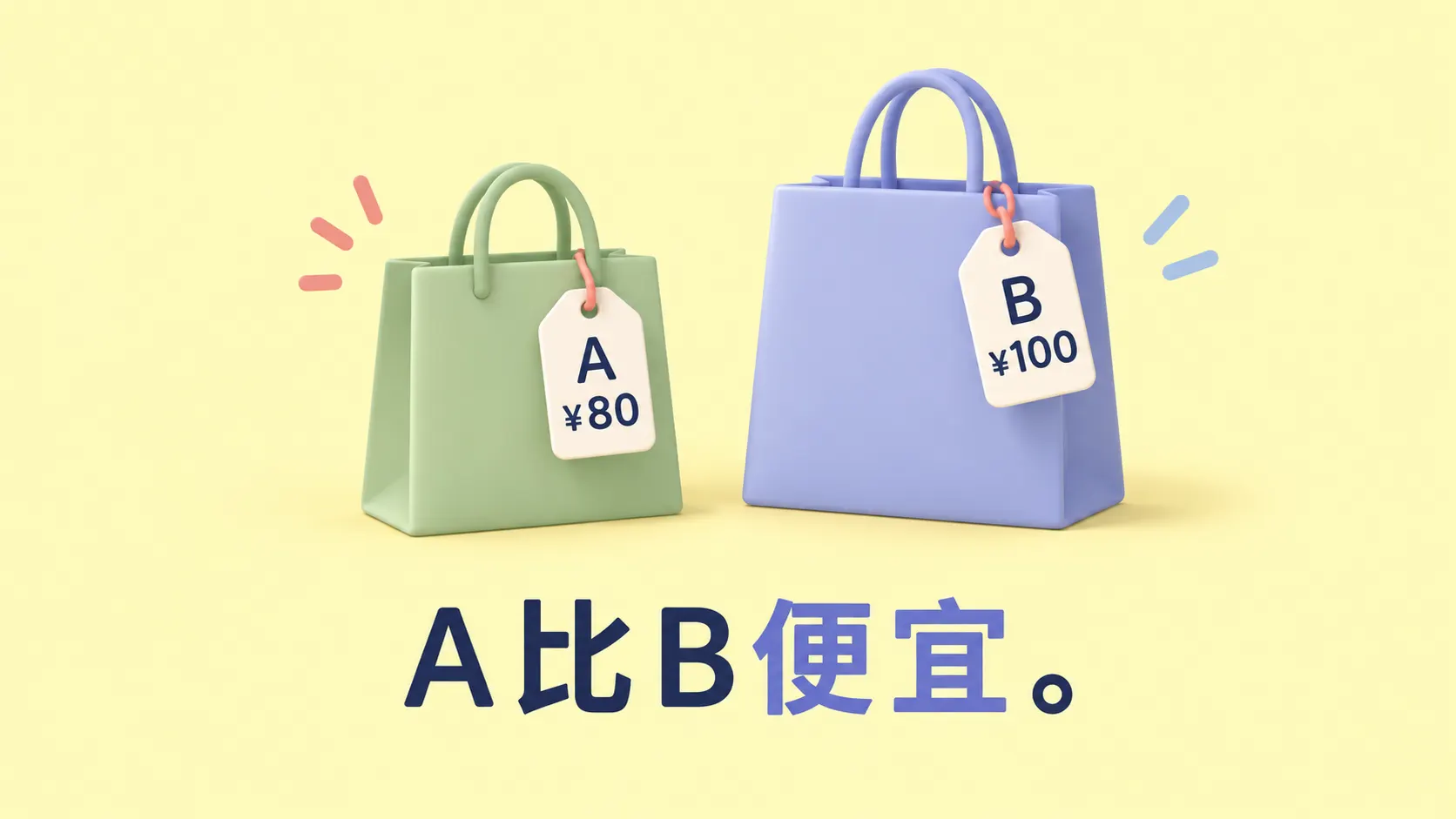
Say how much the difference is
Put a measured difference after the adjective:
这个包比那个包便宜二十块。
Zhège bāo bǐ nàge bāo piányi èrshí kuài.
This bag is twenty yuan cheaper than that one.我姐姐比我大三岁。
Wǒ jiějie bǐ wǒ dà sān suì.
My older sister is three years older than me.
大 compares age here, not body size. Learn the adjective together with the situation.
If you do not need an exact number:
| Expression | Pinyin | Meaning |
|---|---|---|
| 高一点 | gāo yìdiǎn | a little taller |
| 贵一点 | guì yìdiǎn | a little more expensive |
| 远得多 | yuǎn de duō | much farther |
| 便宜很多 | piányi hěn duō | much cheaper |
新办公室比这里远一点。
Xīn bàngōngshì bǐ zhèlǐ yuǎn yìdiǎn.
The new office is a little farther away than this place.
一点 follows the adjective. You are describing the size of the difference, not adding “very” to the adjective.
Not as … as with 没有
A + 没有 + B + adjective
这个包没有那个包贵。
Zhège bāo méiyǒu nàge bāo guì.
This bag is not as expensive as that one.我没有姐姐高。
Wǒ méiyǒu jiějie gāo.
I am not as tall as my older sister.
Here 没有 does not mean “does not possess.” It is part of a comparison. You may also hear 那么 before the adjective: 没有那个包那么贵.
For a wider explanation of these comparison patterns, see Mango Languages’ Mandarin comparison lesson.
Equal in a particular way with 一样
A + 和 / 跟 + B + 一样 + adjective
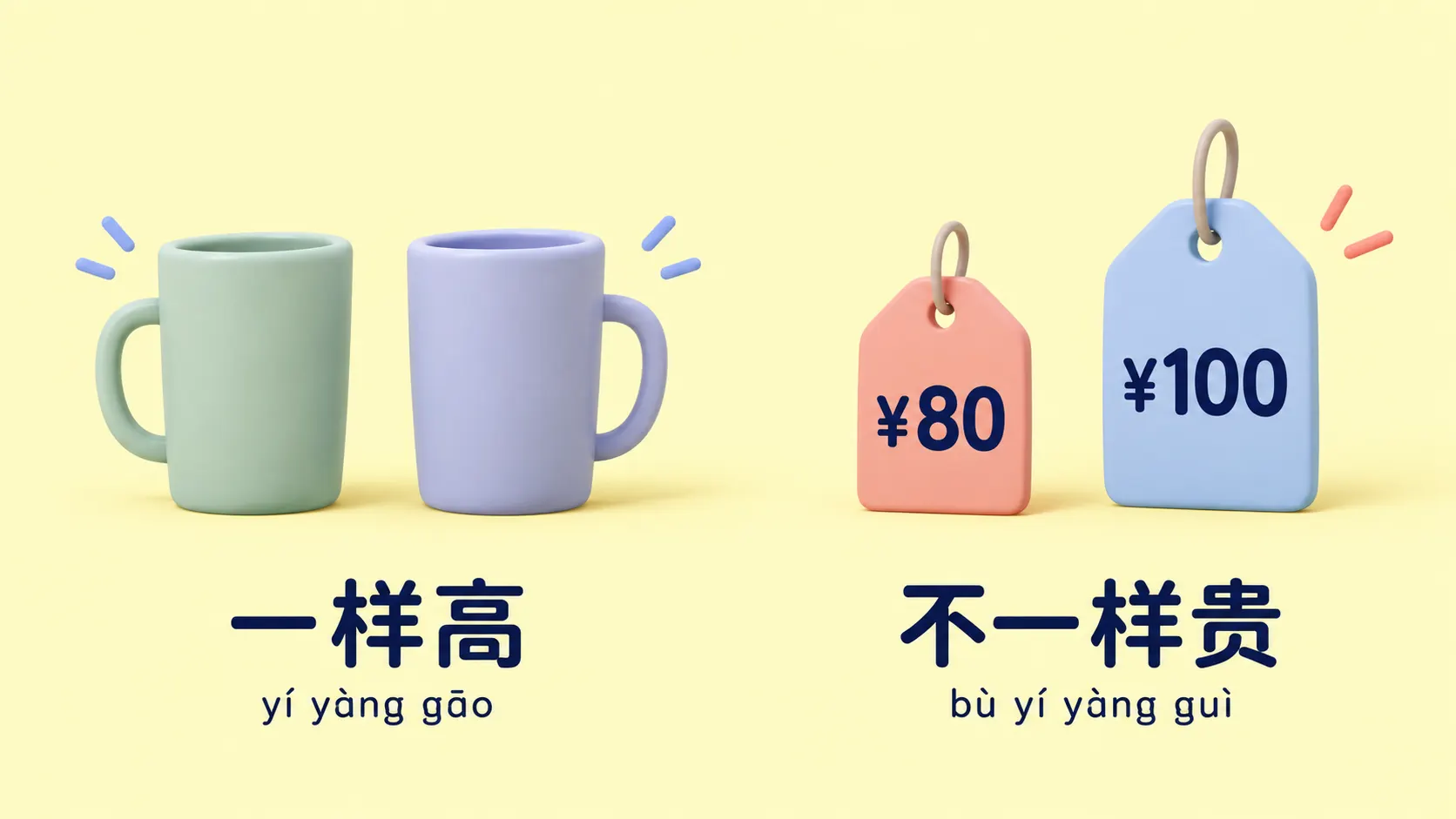
这两个杯子一样高。
Zhè liǎng ge bēizi yíyàng gāo.
These two cups are the same height.这个包和那个包一样贵。
Zhège bāo hé nàge bāo yíyàng guì.
This bag is as expensive as that one.我的房间跟你的房间一样大。
Wǒ de fángjiān gēn nǐ de fángjiān yíyàng dà.
My room is the same size as yours.
The adjective tells the listener which dimension is equal. Two bags can be equally expensive while differing in color and size.
不一样 means “not the same”:
这两个包的价格不一样。
Zhè liǎng ge bāo de jiàgé bù yíyàng.
These two bags have different prices.
不比 and 没有 are not identical
Suppose someone says that Bag A must be more expensive.
A不比B贵。
A bù bǐ B guì.
A is not more expensive than B.
This denies “more expensive.” A might cost the same or less.
By contrast:
A没有B贵。
A méiyǒu B guì.
A is not as expensive as B.
This presents A as cheaper. If both bags cost 100 yuan, 一样贵 fits; 没有B贵 does not describe equality.
A useful practice habit is to write the prices first, then choose the sentence. It prevents English “not more” and “not as” from blending together.
Compare equivalent things
Compare a price with a price, a room with a room, or a journey with a journey.
这里的咖啡比那里的咖啡便宜。
Zhèlǐ de kāfēi bǐ nàlǐ de kāfēi piányi.
Coffee here is cheaper than coffee there.
Do not accidentally compare coffee with a location if the result sounds unclear. Context sometimes permits shortened comparisons, but full matching phrases help you learn the structure.
A shopping conversation
A: 你喜欢哪个包?
Nǐ xǐhuan nǎge bāo?
Which bag do you like?
B: 这个。它比那个便宜二十块。
Zhège. Tā bǐ nàge piányi èrshí kuài.
This one. It is twenty yuan cheaper than that one.
A: 它们一样大吗?
Tāmen yíyàng dà ma?
Are they the same size?
B: 不一样。这个小一点。
Bù yíyàng. Zhège xiǎo yìdiǎn.
No. This one is a little smaller.
The last answer can omit the comparison object because the two bags are already established.
Practice
Use these facts: A costs 80 yuan; B costs 100 yuan; C costs 100 yuan.
- Say A is cheaper than B.
- Say B is twenty yuan more expensive than A.
- Use 没有 to compare A and B.
- Say B and C cost the same.
- Does C不比B贵 allow equality?
- Correct 今天比昨天很冷.
Answers
- A比B便宜。 (A bǐ B piányi.)
- B比A贵二十块。 (B bǐ A guì èrshí kuài.)
- A没有B贵。 (A méiyǒu B guì.)
- B和C一样贵。 (B hé C yíyàng guì.)
- Yes. C is not more expensive, and the prices are equal.
- 今天比昨天冷。 (Jīntiān bǐ zuótiān lěng.)
Frequently asked questions
Do adjectives need a special comparative ending?
No. The 比 construction establishes the comparison.
Can I put 很 in a basic 比 sentence?
Do not use A比B很高. To express a large difference, use a form such as 高很多.
Does 一样 mean identical in every way?
Not when followed by a specific adjective. 一样高 means equal in height.
Is 没有 always about possession?
No. In the comparison pattern it means “not as … as.”
Choose two real objects and compare one quality at a time. Then add a measured difference only if you actually know it.
Comparisons: Key Points
Keep learning: Explore Chinese Grammar Guide and Chinese Vocabulary Hub for related lessons.