
把 Sentences in Chinese: Objects, Results, and Common Mistakes
You know how to say “I read a book.” Now you want to say “I finished that book,” “Put this book on the table,” or “Please give the book back to me.” Chinese often uses 把 (bǎ) when the conversation is about a particular thing and what someone does to it.
The useful question is: What happens to this object? Start with a recognizable object, then describe its result, destination, or treatment.
This lesson introduces practical 把 sentences for everyday tasks. You will also learn why moving an object before a verb does not automatically produce a natural sentence.
The basic pattern
Subject + 把 + object + verb + additional information
我把这本书看完了。
Wǒ bǎ zhè běn shū kàn wán le.
I finished reading this book.
- 我 identifies the person doing the action.
- 这本书 identifies the book.
- 看完了 tells us that the reading reached completion.
Compare:
我看了这本书。
Wǒ kàn le zhè běn shū.
I read this book.
This reports reading the book; it does not explicitly say you finished it. In the first sentence, 完 (wán) supplies that completion meaning. 把 itself does not mean “finish.”
A common beginner use of 把 is to describe a change in an object’s location or state. See the location and result patterns in DigMandarin’s lesson on 把 sentences.
Start with an object the listener can identify
The object after 把 is usually something specific or already understood in the conversation:
| Object | Pinyin | Meaning |
|---|---|---|
| 这本书 | zhè běn shū | this book |
| 那杯水 | nà bēi shuǐ | that glass of water |
| 我的手机 | wǒ de shǒujī | my phone |
| 门 | mén | the door, understood from context |
You do not need 这 or 那 every time. If you are standing beside an open door, 门 is identifiable without an extra demonstrative.
请把门关上。
Qǐng bǎ mén guān shàng.
Please close the door.
For beginner practice, use objects such as this book, your bag, and the door. This helps you choose a clear situation. It is a practice strategy, not a claim that every 把 object must contain a particular word.
Pattern 1: Put something somewhere
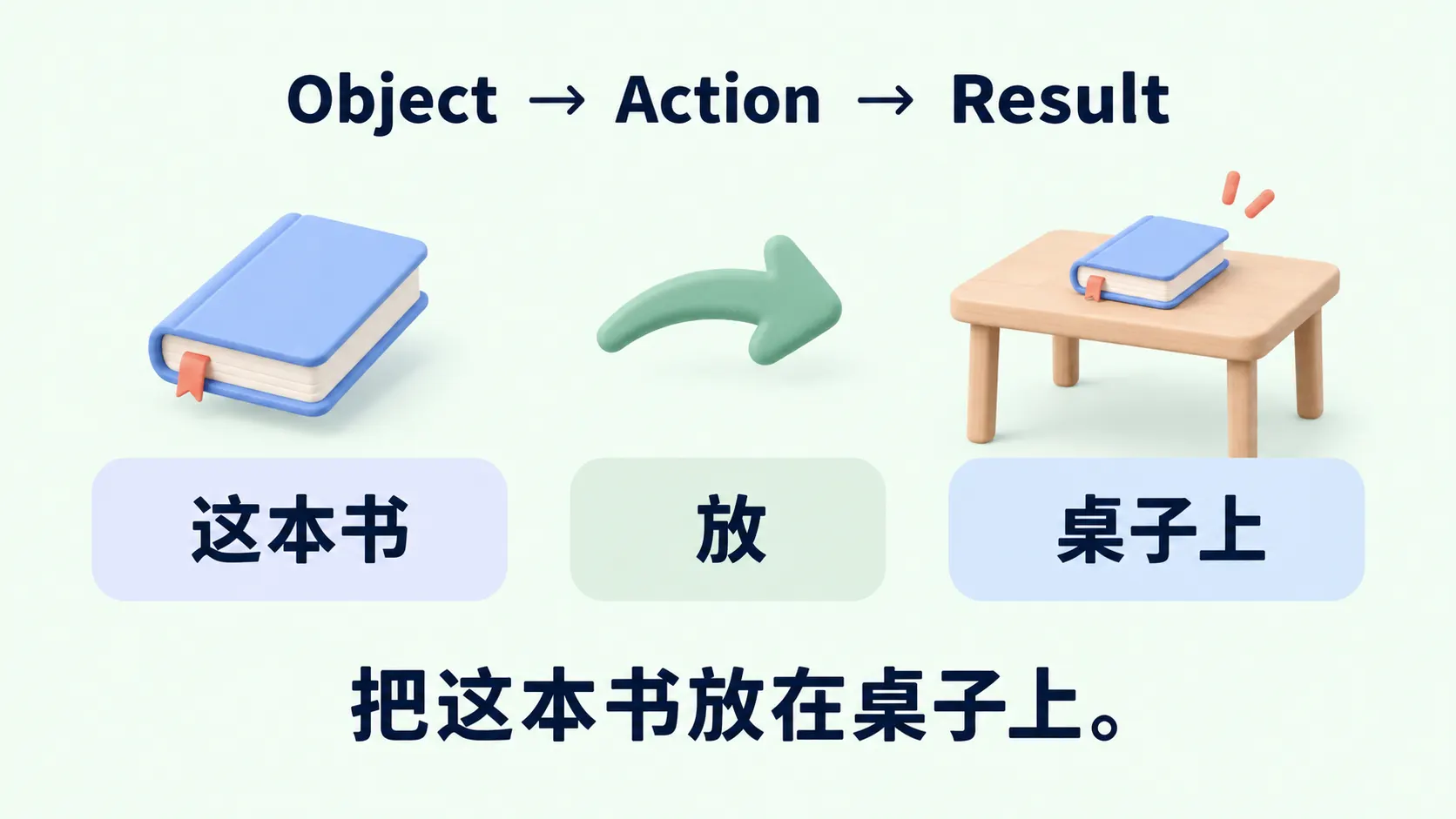
把 + object + 放在 + place
请把这本书放在桌子上。
Qǐng bǎ zhè běn shū fàng zài zhuōzi shàng.
Please put this book on the table.我把手机放在包里了。
Wǒ bǎ shǒujī fàng zài bāo lǐ le.
I put my phone in the bag.你可以把杯子放在这里。
Nǐ kěyǐ bǎ bēizi fàng zài zhèlǐ.
You can put the cup here.
The location completes the practical instruction. 把这本书放 leaves the listener waiting for more information in this context: put the book where?
Compare a statement about an existing location:
书在桌子上。
Shū zài zhuōzi shàng.
The book is on the table.
This simply says where the book is. There is no placement action, so an ordinary 在 sentence works.
Pattern 2: Show a result
Several short words after a verb tell you how the action ends:
| Verb phrase | Pinyin | Result |
|---|---|---|
| 看完 | kàn wán | finish reading or watching |
| 吃完 | chī wán | finish eating |
| 洗干净 | xǐ gānjìng | wash clean |
| 关好 | guān hǎo | close properly |
| 写好 | xiě hǎo | finish preparing something in writing |
我把午饭吃完了。
Wǒ bǎ wǔfàn chī wán le.
I finished my lunch.她把杯子洗干净了。
Tā bǎ bēizi xǐ gānjìng le.
She washed the cup clean.我已经把地址写好了。
Wǒ yǐjīng bǎ dìzhǐ xiě hǎo le.
I have already written down the address.
Notice the difference between doing an action and achieving a result. Someone can wash a cup without getting it completely clean. 洗干净 specifically says that the cleaning succeeded.
Not every 把 sentence needs 完, and not every one describes a finished action. A destination, direction, repetition, or another suitable expression can also complete the verb phrase.
Pattern 3: Give or return something to someone
把 + object + 给 / 还给 + person
请把那支笔给我。
Qǐng bǎ nà zhī bǐ gěi wǒ.
Please give me that pen.我明天把这本书还给你。
Wǒ míngtiān bǎ zhè běn shū huán gěi nǐ.
I will return this book to you tomorrow.
Here 还 is huán, “return,” rather than hái, “still” or “also.”
The second sentence refers to tomorrow. It demonstrates why 把 is not a past-tense marker. Time words and the rest of the sentence establish the timing.
Put negation and modal verbs before 把
For these everyday patterns, use:
Subject + 没 / 别 / 想 / 能 + 把 + object + verb phrase
我还没把门关好。
Wǒ hái méi bǎ mén guān hǎo.
I haven’t properly closed the door yet.别把手机放在那里。
Bié bǎ shǒujī fàng zài nàlǐ.
Don’t put your phone there.我想把这本书带回家。
Wǒ xiǎng bǎ zhè běn shū dài huí jiā.
I want to take this book home.你能把窗户打开吗?
Nǐ néng bǎ chuānghu dǎ kāi ma?
Can you open the window?
Use 没 for an action or result that has not happened, and 别 for “don’t” in an instruction. 不 can also occur before 把 when the meaning calls for it, such as refusal:
我不把密码告诉他。
Wǒ bù bǎ mìmǎ gàosu tā.
I won’t tell him the password.
Do not memorize “把 only works with 没.” Choose the negative according to the meaning. Review negation in Chinese if you need more practice.
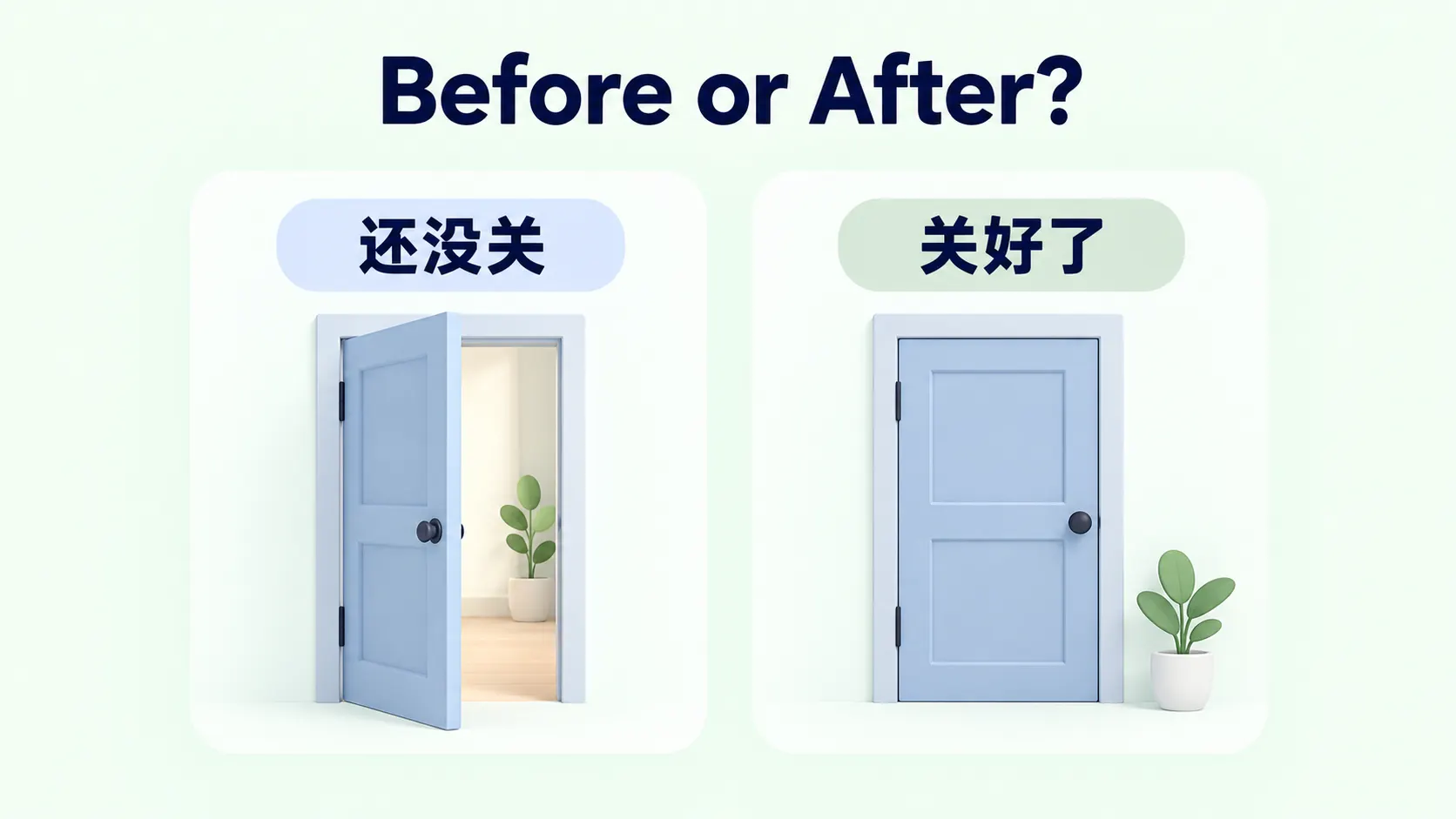
The image compares 还没关 and 关好了. In a full sentence, the object fits between 把 and the action: 我还没把门关好。
Three common mistakes
1. Using 把 with every verb
For a simple preference, say:
我喜欢这本书。
Wǒ xǐhuan zhè běn shū.
I like this book.
Do not change it to 我把这本书喜欢. Liking something does not fit the action-and-treatment pattern being taught here.
2. Ending with an unsupported bare verb
Instead of 我把这本书看, decide what you actually mean:
我把这本书看完了。
Wǒ bǎ zhè běn shū kàn wán le.
I finished reading this book.
If you simply mean that you are reading, use an ordinary sentence:
我在看这本书。
Wǒ zài kàn zhè běn shū.
I am reading this book.
3. Adding 了 automatically
A request can be complete without 了:
请把名字写在这里。
Qǐng bǎ míngzi xiě zài zhèlǐ.
Please write your name here.
Do not add 了 merely because you see 把. It needs its own role in the sentence.
A short dialogue: Getting ready to leave
A: 你把书放在哪里了?
Nǐ bǎ shū fàng zài nǎlǐ le?
Where did you put the book?
B: 我把书放在桌子上了。
Wǒ bǎ shū fàng zài zhuōzi shàng le.
I put it on the table.
A: 好。请把窗户关上。
Hǎo. Qǐng bǎ chuānghu guān shàng.
Okay. Please close the window.
B: 我已经把窗户关好了。
Wǒ yǐjīng bǎ chuānghu guān hǎo le.
I’ve already closed the window properly.
A: 谢谢,我们走吧。
Xièxie, wǒmen zǒu ba.
Thanks. Let’s go.
The final 吧 (ba) is a different character and particle from 把 (bǎ).
Practice
- Arrange: 我 / 把 / 看完了 / 这本书.
- Translate: “Please put the cup here.”
- Add 没 in the correct position: 我把门关好.
- Translate: “I want to take this book home.”
- Correct this sentence to mean “I like this book”: 我把这本书喜欢。
- Which sentence explicitly says the reading is finished: 我看了这本书。 or 我把这本书看完了。?
- Does 我明天把书还给你。 need 了 just because it contains 把?
Answers
- 我把这本书看完了。 — Wǒ bǎ zhè běn shū kàn wán le.
- 请把杯子放在这里。 — Qǐng bǎ bēizi fàng zài zhèlǐ.
- 我没把门关好。 — Wǒ méi bǎ mén guān hǎo. I did not close the door properly.
- 我想把这本书带回家。 — Wǒ xiǎng bǎ zhè běn shū dài huí jiā.
- 我喜欢这本书。 — Wǒ xǐhuan zhè běn shū.
- 我把这本书看完了。 The completion meaning comes from 完.
- No. It means “I’ll return the book to you tomorrow” and is complete as written.
Frequently asked questions
Does 把 mean “take”?
把 has other uses, but in this sentence structure it is best learned as a grammatical marker. Translating every instance as “take” produces awkward English and hides the actual action verb.
Is a 把 sentence passive?
No. In 我把门关上了, “I” still performs the action. 把 reorganizes how the object and action are presented; it does not turn the sentence into a passive.
Must every 把 sentence end in 了?
No. Requests, plans, and other sentences can work without it: 请把门关上。 and 我明天把书还给你。 are two examples.
Can I always replace a normal sentence with 把?
No. The verb, object, and intended meaning must support the construction. First learn reliable combinations such as 把书放在桌子上, 把饭吃完, and 把门关好.
For broader practice, revisit Chinese sentence structure, then describe three real tasks: putting away a book, finishing a meal, and closing a door.