
Ordering Food in Chinese: Menu Words and Restaurant Dialogues
Ordering food in Chinese becomes easier when you treat it as a short sequence: find a dish, choose the quantity, confirm any preferences, and check whether the meal is for here or to go.
You do not need to understand every character on a menu before you can order. A few food words, measure words, and questions let you ask for the information you need.
This guide follows a simple restaurant visit, with Chinese, pinyin, English translations, and a complete practice dialogue. Menu items and prices are illustrative rather than a real restaurant’s current offer.
Start with a few restaurant words
| Chinese | Pinyin | Meaning |
|---|---|---|
| 菜单 | càidān | menu |
| 点菜 | diǎn cài | order dishes |
| 米饭 | mǐfàn | cooked rice |
| 面条 | miàntiáo | noodles |
| 饺子 | jiǎozi | dumplings |
| 汤 | tāng | soup |
| 茶 | chá | tea |
| 水 | shuǐ | water |
| 买单 | mǎidān | pay the bill |
| 打包 | dǎbāo | pack to take away |
菜 can mean a dish, food, or vegetables in different contexts. A 菜单 is not necessarily a list of vegetable dishes.
At a table, you can ask:
可以看一下菜单吗?
Kěyǐ kàn yíxià càidān ma?
Could I see the menu?
When you are ready:
我们可以点菜了吗?
Wǒmen kěyǐ diǎn cài le ma?
Can we order now?
Some restaurants use printed menus, some use screens or QR menus, and others take orders at a counter. These sentences express the communication task without depending on one ordering system.
Read a dish name in useful pieces
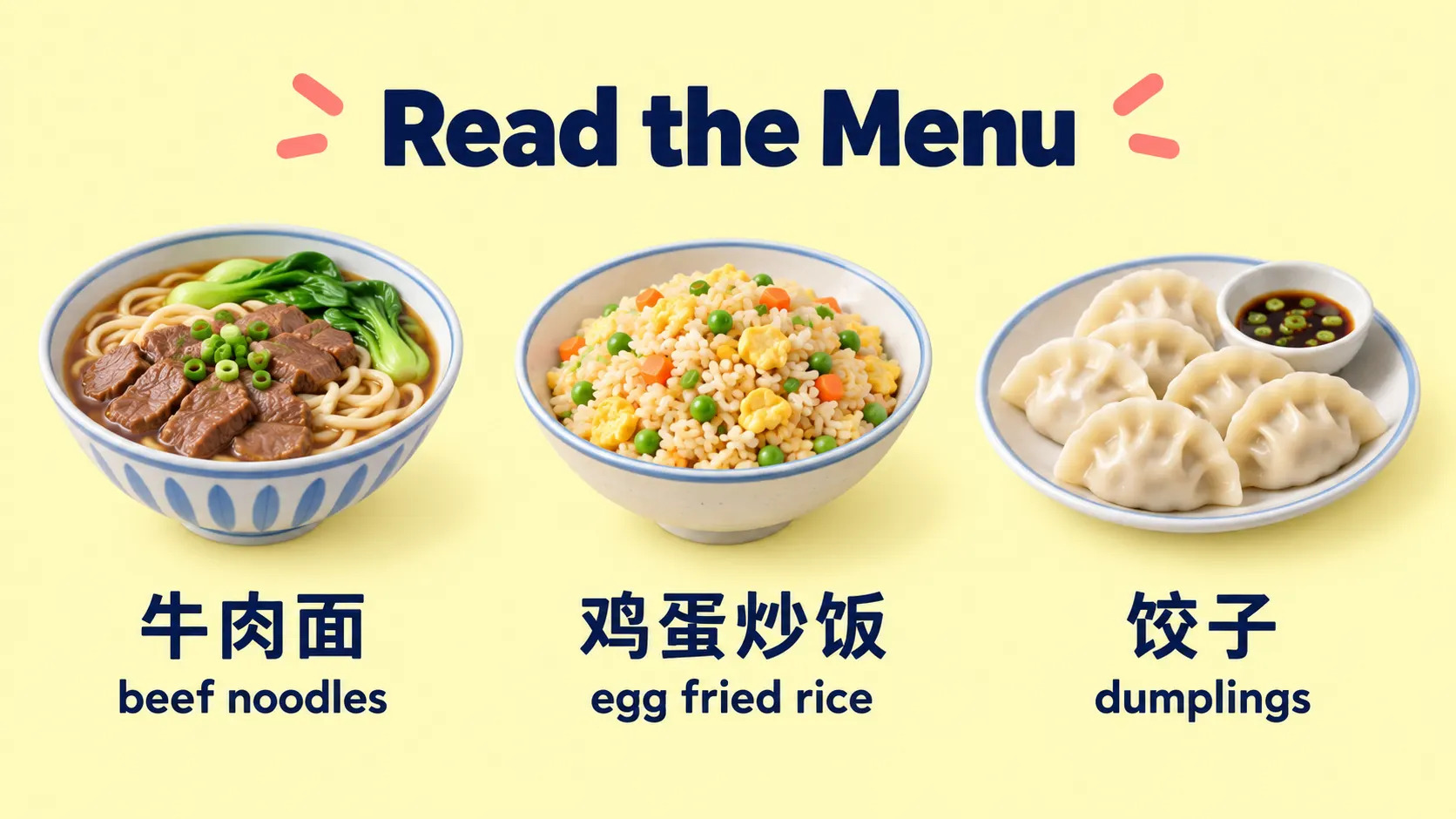
Recognizing a few ingredients and cooking words helps you make an informed guess.
牛肉面
Niúròu miàn
Beef noodles
牛肉 identifies beef; 面 identifies noodles.
鸡蛋炒饭
Jīdàn chǎofàn
Egg fried rice
鸡蛋 means egg, and 炒饭 means fried rice.
番茄鸡蛋汤
Fānqié jīdàn tāng
Tomato and egg soup
The ending 汤 tells you this is a soup.
Other useful pieces include 鸡肉 (jīròu, chicken), 猪肉 (zhūròu, pork), 鱼 (yú, fish), and 豆腐 (dòufu, tofu).
A dish name is not a complete ingredient list. Recipes vary, and some names are figurative. If you need to know what is in a dish, ask rather than relying entirely on character-by-character translation.
这个菜里面有什么?
Zhège cài lǐmiàn yǒu shénme?
What is in this dish?
Order with a number and a measure word
A flexible pattern is:
我要 + number + measure word + food
我要一碗牛肉面。
Wǒ yào yì wǎn niúròu miàn.
I’d like a bowl of beef noodles.
我们要两份饺子。
Wǒmen yào liǎng fèn jiǎozi.
We’d like two portions of dumplings.
请给我一杯水。
Qǐng gěi wǒ yì bēi shuǐ.
Please give me a glass of water.
Here are four measure words worth practicing:
| Word | Typical use | Example |
|---|---|---|
| 碗 wǎn | a bowl | 一碗面 |
| 份 fèn | a portion/serving | 一份炒饭 |
| 杯 bēi | a cup/glass | 一杯茶 |
| 盘 pán | a plateful | 一盘饺子 |
Use the serving unit on the menu when available. A portion is not a universal size, and dumplings might be sold by plate, portion, weight, or number.
That’s Mandarin’s food-ordering guide includes the useful 我要一份/一个/一碗 pattern. The restaurant examples here apply that idea to a short in-person order.
“I want” can be an ordinary ordering phrase
English learners sometimes worry that 我要 sounds too blunt because “I want” can be demanding in English. In a normal Chinese ordering context, 我要 is a common way to state an order.
You can also say:
我想要一份炒饭。
Wǒ xiǎng yào yí fèn chǎofàn.
I’d like a portion of fried rice.
A clear tone, thanks, and a reasonable request do more than translating English politeness word for word.
If you cannot read the dish name, point to the item and ask:
我要这个,可以吗?
Wǒ yào zhège, kěyǐ ma?
I’d like this one. Is that possible?
Then confirm the name or number of portions before the order is finalized.
Ask about flavor and size
这个辣吗?
Zhège là ma?
Is this spicy?
可以少放一点辣椒吗?
Kěyǐ shǎo fàng yìdiǎn làjiāo ma?
Could you use a little less chili?
不要香菜,谢谢。
Bú yào xiāngcài, xièxie.
No cilantro, please. Thank you.
These express preferences. Whether a kitchen can change a dish depends on how it is prepared, so listen for the response rather than assuming every modification is possible.
For serving size:
一份有多少个饺子?
Yí fèn yǒu duōshao ge jiǎozi?
How many dumplings are in one portion?
有小份的吗?
Yǒu xiǎo fèn de ma?
Is there a smaller portion?
A specific question gives you more useful information than assuming that every bowl or plate has a familiar size.
For here or to go?
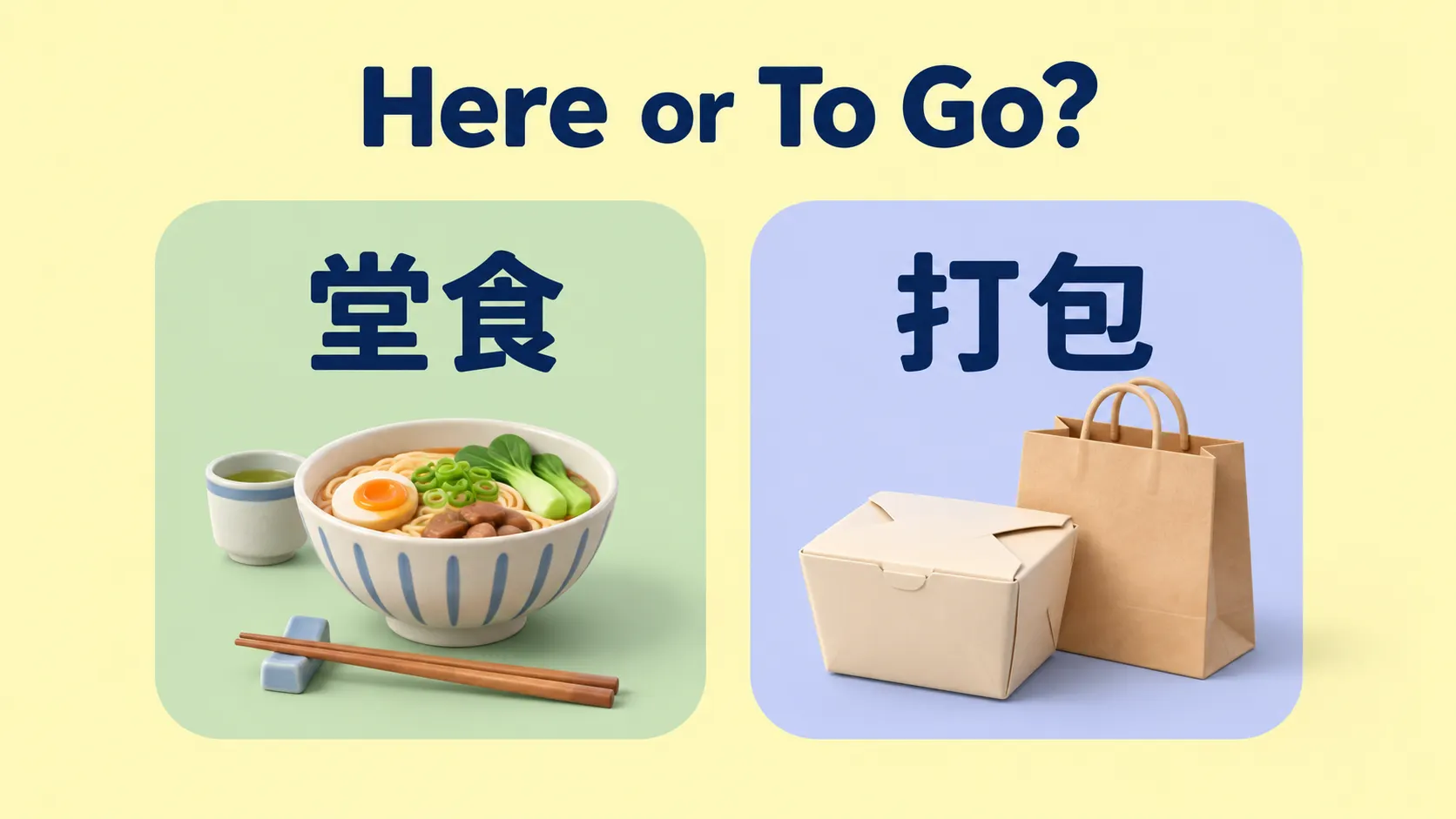
At a counter, you might hear:
堂食还是打包?
Tángshí háishi dǎbāo?
For here or to go?
堂食 (tángshí) means dining in. 打包 (dǎbāo) means packing the food to take away.
Simple replies are enough:
堂食,谢谢。
Tángshí, xièxie.
For here, thank you.
打包,谢谢。
Dǎbāo, xièxie.
To go, thank you.
You can also ask to pack leftovers after a meal:
这些可以打包吗?
Zhèxiē kěyǐ dǎbāo ma?
Can these be packed to take away?
外卖 (wàimài) often refers to food sold for takeaway or delivery, especially delivery services in everyday contexts. It is related to 打包, but the words describe different aspects of the situation.
A complete counter-order dialogue
Staff:您好,吃点什么?
Nínhǎo, chī diǎn shénme?
Hello. What would you like?
Customer:我要一碗牛肉面。
Wǒ yào yì wǎn niúròu miàn.
I’d like a bowl of beef noodles.
Staff:要辣椒吗?
Yào làjiāo ma?
Would you like chili?
Customer:少放一点,谢谢。
Shǎo fàng yìdiǎn, xièxie.
Just a little, please. Thank you.
Staff:堂食还是打包?
Tángshí háishi dǎbāo?
For here or to go?
Customer:堂食。再要一杯水。
Tángshí. Zài yào yì bēi shuǐ.
For here. And a glass of water.
Staff:好的,一共二十八元。
Hǎo de, yígòng èrshíbā yuán.
Okay, twenty-eight yuan altogether.
Customer:好的,谢谢。
Hǎo de, xièxie.
Okay, thank you.
The order develops one detail at a time. You do not need to deliver every preference in one long sentence.
Confirm an unclear order
If you are unsure whether the server heard you correctly, repeat the key item:
一碗牛肉面,对吗?
Yì wǎn niúròu miàn, duì ma?
One bowl of beef noodles, correct?
If you receive the wrong drink:
不好意思,我点的是茶,不是咖啡。
Bù hǎoyìsi, wǒ diǎn de shì chá, bú shì kāfēi.
Excuse me, I ordered tea, not coffee.
Keep the correction specific. State what you ordered and what differs, rather than trying to explain the entire interaction at once.
To ask for the bill at a table:
麻烦买单。
Máfan mǎidān.
The bill, please.
Payment may happen before or after eating depending on the restaurant. Follow the setting and ask if you are unsure.
Practice
- Order one portion of egg fried rice.
- Ask whether a dish is spicy.
- Say you want two cups of tea.
- Reply “to go, thank you.”
- Ask how many dumplings are in a portion.
- You ordered water, not tea. Make a polite correction.
Suggested answers
- 我要一份鸡蛋炒饭。 (Wǒ yào yí fèn jīdàn chǎofàn.)
- 这个菜辣吗? (Zhège cài là ma?)
- 我要两杯茶。 (Wǒ yào liǎng bēi chá.)
- 打包,谢谢。 (Dǎbāo, xièxie.)
- 一份有多少个饺子? (Yí fèn yǒu duōshao ge jiǎozi?)
- 不好意思,我点的是水,不是茶。 (Bù hǎoyìsi, wǒ diǎn de shì shuǐ, bú shì chá.)
Frequently asked questions
Can I use 个 for every food item?
No. Learn a few serving words such as 碗、份、杯 and use the menu’s unit when possible.
Is 我要 rude?
It is common in ordering. Context and delivery matter; 我想要 is another useful option.
Does 不辣 guarantee there is no chili?
It expresses “not spicy,” but descriptions and preparations vary. Ask directly about an ingredient if that is the information you need.
Does 打包 only mean leftovers?
No. It can describe a takeaway order or packing remaining food after a meal.
For more language practice, review measure words. For the cultural side, read shopping and dining etiquette. Then build your own three-item order and practice responding to one follow-up question.