

Dates in Chinese: Years, Months, Days, and Birthdays
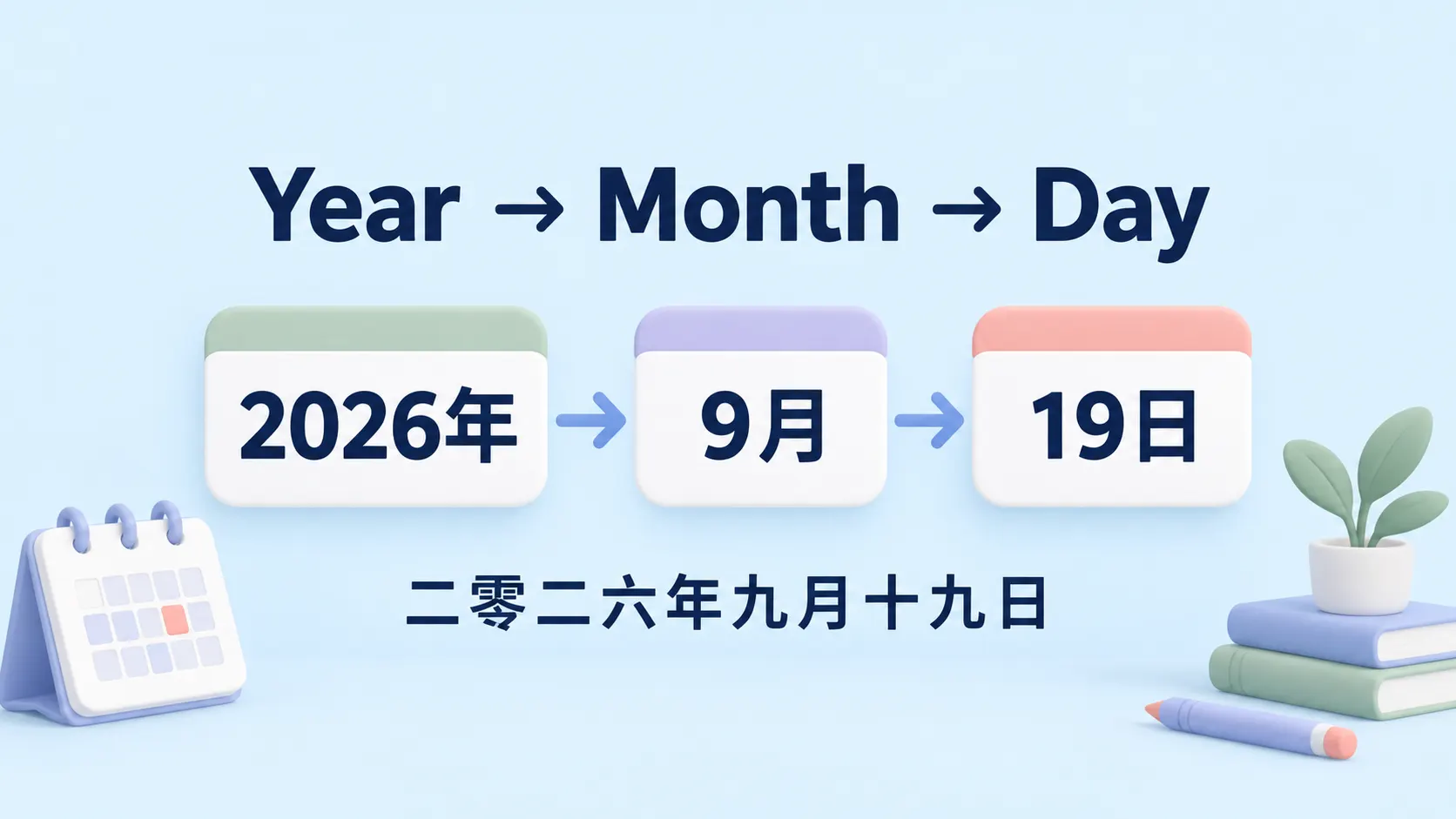
A date such as 09/10 can mean different things in different countries. Chinese full dates avoid much of that uncertainty by moving from the largest unit to the smallest:
Year → month → day
For example, 2026年9月19日 means September 19, 2026.
The more surprising part for many learners is how to read each section. The year is usually read digit by digit, but the month and day are read as numbers. Once you understand that difference, birthdays, appointments, and simple forms become much easier.
This guide covers modern calendar dates in everyday Mandarin. Traditional-calendar dates are a separate topic, noted briefly below.
The three basic date words
| Chinese | Pinyin | Meaning |
|---|---|---|
| 年 | nián | year |
| 月 | yuè | month |
| 日 | rì | day/date, often in writing |
| 号 | hào | day of the month, common in speech |
You can write:
2026年9月19日
And say:
二零二六年九月十九号
Èr líng èr liù nián jiǔ yuè shíjiǔ hào
Using 日 at the end is also possible:
二零二六年九月十九日
Èr líng èr liù nián jiǔ yuè shíjiǔ rì
日 and 号 do not change the date in this use. They reflect different common ways of expressing it.
ChineseClass101’s date guide describes the year–month–day order. The examples and practice below apply that order to dates you might need in a conversation.
Read the year as separate digits
A calendar year is normally read digit by digit:
| Year | Chinese reading | Pinyin |
|---|---|---|
| 1998 | 一九九八年 | yī jiǔ jiǔ bā nián |
| 2005 | 二零零五年 | èr líng líng wǔ nián |
| 2026 | 二零二六年 | èr líng èr liù nián |
Read both zeros in 2005. You are naming the year, not building the quantity “two thousand and five.”
Compare:
二零零五年 — the year 2005.
两千零五个 — a quantity of 2,005 items.
For a beginner, keep the full four-digit year when clarity matters. Shortened years occur in context, but they can be ambiguous when the century is not already clear.
To ask which year:
你是哪一年出生的?
Nǐ shì nǎ yī nián chūshēng de?
What year were you born?
Use questions about age or birth year when appropriate to your relationship and situation, rather than treating them as compulsory small talk.
Months are numbers plus 月
Chinese month names follow a regular pattern.
| Month | Chinese | Pinyin |
|---|---|---|
| January | 一月 | yī yuè |
| February | 二月 | èr yuè |
| March | 三月 | sān yuè |
| April | 四月 | sì yuè |
| May | 五月 | wǔ yuè |
| June | 六月 | liù yuè |
| July | 七月 | qī yuè |
| August | 八月 | bā yuè |
| September | 九月 | jiǔ yuè |
| October | 十月 | shí yuè |
| November | 十一月 | shíyī yuè |
| December | 十二月 | shí’èr yuè |
November is 十一月, not 一一月. Month numbers are quantities in the naming pattern, not digit strings like the year.
Do not confuse 二月 with 两个月:
二月 (èr yuè) means February.
两个月 (liǎng ge yuè) means two months.
The measure word 个 helps mark a duration or number of months rather than a named month.
Add the day with 号 or 日
For the day of the month, use the ordinary number:
五月十二号
Wǔ yuè shí’èr hào
May 12
十月二十一日
Shí yuè èrshíyī rì
October 21
You do not need 第 to turn the day into an English-style ordinal. May 12 is not normally 五月第十二号.
When the month is already known, you can use only the day:
十五号见。
Shíwǔ hào jiàn.
See you on the fifteenth.
For an appointment made far in advance, state the month as well. If a message could be read later, include the year too. Good language use includes enough information for the reader to identify the intended date.
Ask the date and the weekday separately
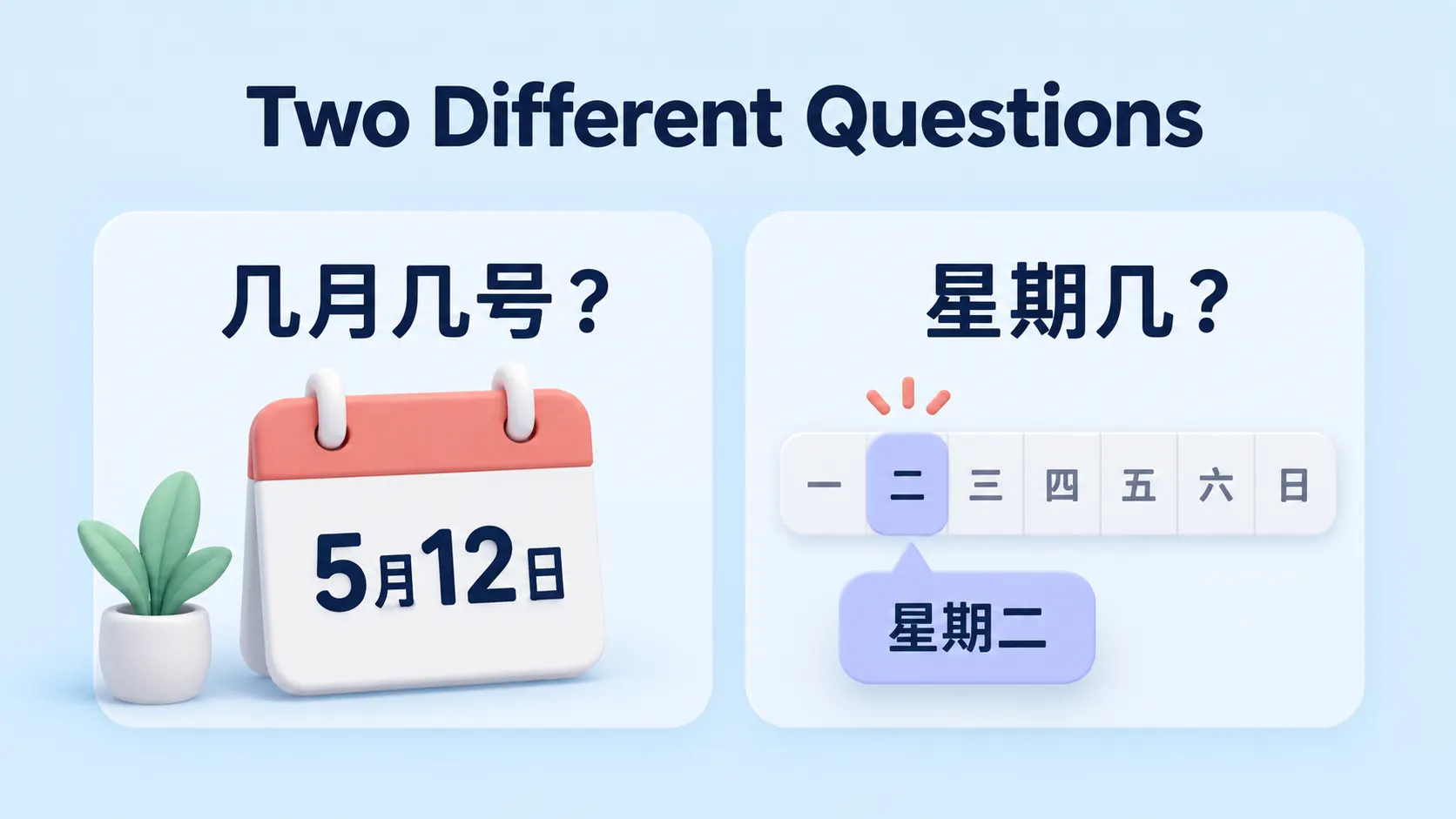
These are different questions:
今天几月几号?
Jīntiān jǐ yuè jǐ hào?
What is today’s date?
今天星期几?
Jīntiān xīngqī jǐ?
What day of the week is it today?
If the month is understood, 今天几号? (Jīntiān jǐ hào?) is enough to ask the day of the month.
For weekdays, use 星期 plus a number from one to six:
| Day | Chinese | Pinyin |
|---|---|---|
| Monday | 星期一 | xīngqī yī |
| Tuesday | 星期二 | xīngqī èr |
| Wednesday | 星期三 | xīngqī sān |
| Thursday | 星期四 | xīngqī sì |
| Friday | 星期五 | xīngqī wǔ |
| Saturday | 星期六 | xīngqī liù |
| Sunday | 星期日 / 星期天 | xīngqī rì / xīngqī tiān |
Sunday is not normally 星期七.
You will also encounter 周一 and 礼拜一 for Monday, and corresponding forms for other days. Learn 星期 first, then recognize these alternatives in schedules and conversation.
Talk about birthdays
你的生日是几月几号?
Nǐ de shēngrì shì jǐ yuè jǐ hào?
What month and day is your birthday?
我的生日是五月十二号。
Wǒ de shēngrì shì wǔ yuè shí’èr hào.
My birthday is May 12.
The question asks for the recurring birthday date, not the person’s age or birth year.
A short birthday greeting is:
生日快乐!
Shēngrì kuàilè!
Happy birthday!
Some people observe birthdays according to the traditional lunisolar calendar, often called 农历 (nónglì). If a date matters for an invitation, clarify which calendar is intended. A lunar date does not correspond to the same Gregorian date every year.
This lesson does not provide lunar-calendar conversions. Check the relevant year’s calendar when you need an actual conversion.
Put the date before the action
Time information normally comes before the main verb in a simple sentence:
我们五月十二号见面。
Wǒmen wǔ yuè shí’èr hào jiànmiàn.
We’ll meet on May 12.
Add a clock time after the date:
我们五月十二号下午三点见面。
Wǒmen wǔ yuè shí’èr hào xiàwǔ sān diǎn jiànmiàn.
We’ll meet at three in the afternoon on May 12.
The order continues from larger to smaller: date, part of day, clock time. You can also place the entire time phrase at the start of the sentence.
To state a range:
从五月十二号到五月十五号
Cóng wǔ yuè shí’èr hào dào wǔ yuè shíwǔ hào
From May 12 to May 15
For a real booking, check whether the end date describes a final activity day, a departure day, or something else. The language alone does not settle the service’s counting rules.
A birthday-plan conversation
A:你的生日是几月几号?
Nǐ de shēngrì shì jǐ yuè jǐ hào?
What is the date of your birthday?
B:五月十二号。
Wǔ yuè shí’èr hào.
May 12.
A:我们那天下午一起喝茶,好吗?
Wǒmen nà tiān xiàwǔ yìqǐ hē chá, hǎo ma?
Shall we have tea together that afternoon?
B:好,三点可以。
Hǎo, sān diǎn kěyǐ.
Sure, three works.
A:好,五月十二号下午三点见。
Hǎo, wǔ yuè shí’èr hào xiàwǔ sān diǎn jiàn.
Great, see you at three on May 12.
The final line replaces the vague 那天, “that day,” with the actual date. Repeating it makes the agreement easy to check.
Practice
- Read 2008年 digit by digit.
- Write November in Chinese.
- Write March 25 using 号.
- Ask what day of the week today is.
- Explain the difference between 三月 and 三个月.
- Correct 星期七.
- Say “My birthday is October 6.”
Answers
- 二零零八年 (èr líng líng bā nián).
- 十一月 (shíyī yuè).
- 三月二十五号 (sān yuè èrshíwǔ hào).
- 今天星期几? (Jīntiān xīngqī jǐ?)
- 三月 is March; 三个月 (sān ge yuè) is three months.
- 星期日 or 星期天.
- 我的生日是十月六号。 (Wǒ de shēngrì shì shí yuè liù hào.)
Frequently asked questions
Is 号 only informal?
号 is very common for dates in speech. 日 is common in formal writing and can also be spoken. Choose a form that fits the context.
Do I read 2026 as a quantity?
For the calendar year, use 二零二六, digit by digit.
Does 几号 ask the weekday?
No. It asks the day of the month. 星期几 asks the weekday.
Should I use 两月 for February?
Use 二月 for February. 两个月 expresses a duration of two months.
Practice writing three dates that matter to you, then add a time to one of them. If you need help building the question, revisit Chinese question words. The goal is a date another person can identify without guessing your preferred numeric format.
Dates: Key Points
Keep learning: Explore Chinese Grammar Guide and Chinese Vocabulary Hub for related lessons.