

How to Tell Time in Chinese: Hours, Minutes, and Making Plans
You can recognize the numbers on a clock, but arranging a meeting requires more than reading digits. Is it morning or afternoon? Does 三点 mean three o’clock or three hours? Where does “tomorrow” go in the sentence?
Chinese clock expressions are built from a few reusable parts. Once you know 点 (diǎn), 分 (fēn), 半 (bàn), and the words for parts of the day, you can use them in plans, questions, and everyday schedules.
This lesson separates clock time from duration and gives you a short conversation to practice both.
Ask what time it is
现在几点?
Xiànzài jǐ diǎn?
What time is it now?
A slightly longer version is:
现在几点了?
Xiànzài jǐ diǎn le?
What time is it now?
Both can ask the current time. The final 了 can connect the question to the current situation; it does not turn the question into past tense.
When approaching someone, you can add 请问:
请问,现在几点?
Qǐngwèn, xiànzài jǐ diǎn?
Excuse me, what time is it?
To ask about an event, put 几点 where its time would go:
你几点下班?
Nǐ jǐ diǎn xiàbān?
What time do you finish work?
Read the hour first
The basic pattern is:
Hour + 点
| Time | Chinese | Pinyin |
|---|---|---|
| 1:00 | 一点 | yì diǎn |
| 2:00 | 两点 | liǎng diǎn |
| 3:00 | 三点 | sān diǎn |
| 8:00 | 八点 | bā diǎn |
| 10:00 | 十点 | shí diǎn |
| 12:00 | 十二点 | shí’èr diǎn |
In everyday speech, use 两点 for two o’clock. The 二 in 十二点 stays 二; twelve is not 十两.
You may also hear 点钟, as in 三点钟 (sān diǎn zhōng). For ordinary clock readings, 点 is often enough.
Do not read a clock as a list of independent digits. 12:00 is 十二点, not 一二零零.
Add minutes, half hours, and quarters
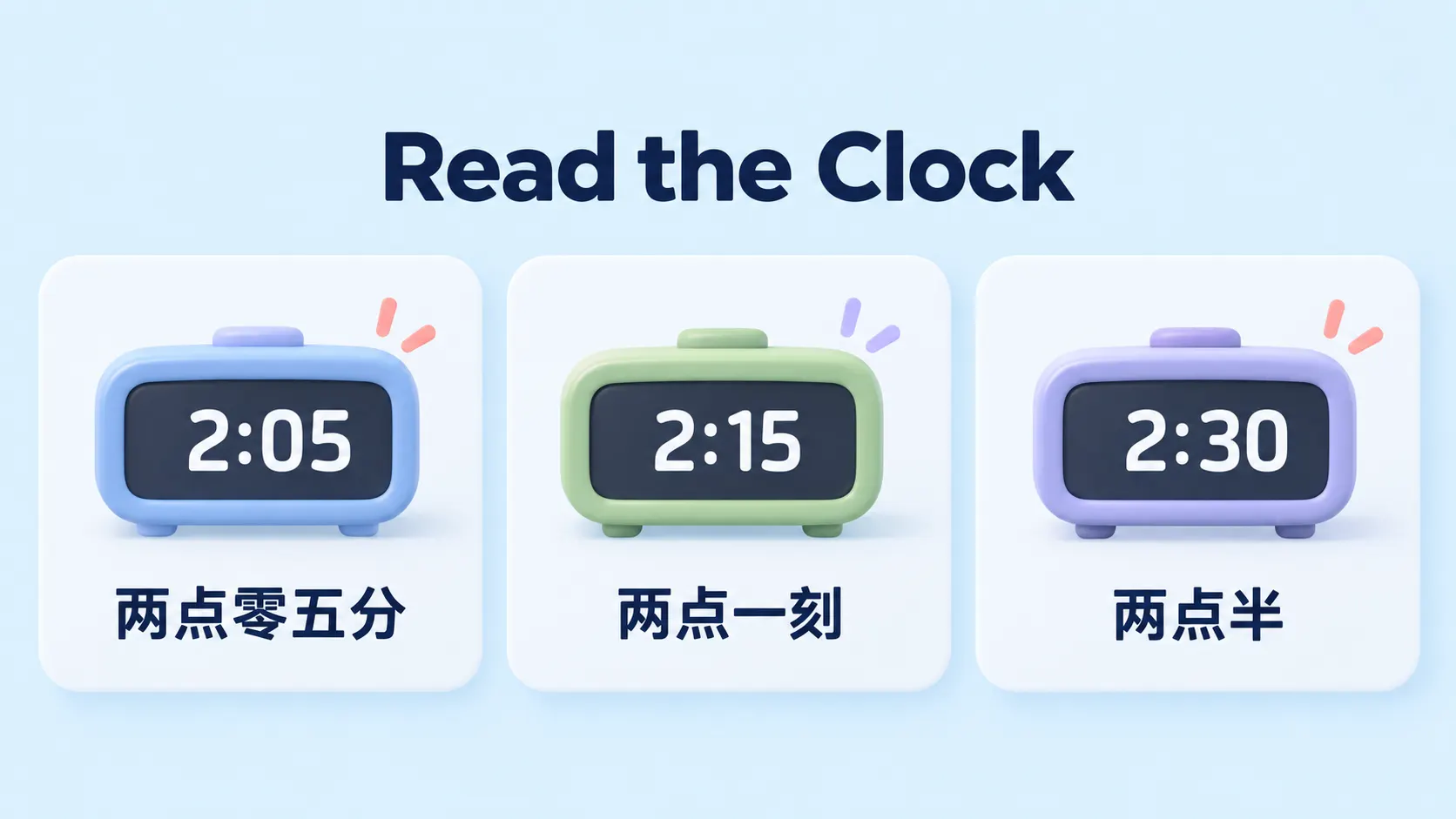
For minutes, follow the hour with the number of minutes:
Hour + 点 + minutes + 分
八点二十分
Bā diǎn èrshí fēn
8:20
For a single-digit minute, the full clear form includes 零:
两点零五分
Liǎng diǎn líng wǔ fēn
2:05
In everyday conversation, you may hear shorter readings, but the full form helps you practice accurately.
Two other useful words are 半, “half,” and 刻, “quarter”:
| Time | Full minute form | Alternative |
|---|---|---|
| 2:15 | 两点十五分 | 两点一刻 |
| 2:30 | 两点三十分 | 两点半 |
| 2:45 | 两点四十五分 | 两点三刻 |
Read the alternatives as liǎng diǎn yí kè, liǎng diǎn bàn, and liǎng diǎn sān kè.
Notice the word order: Chinese places the hour first. “Half past two” becomes “two o’clock half.” That’s Mandarin’s guide to time expressions illustrates this hour-first order and the use of 零 in minute readings.
Minute forms are a good default if you find quarter expressions difficult. 两点四十五分 is fully understandable.
Make morning and afternoon clear
A bare 三点 does not tell you whether the meeting is at 3 a.m. or 3 p.m. Context may make that obvious, but a plan is clearer with a part of the day.
| Expression | Pinyin | General meaning |
|---|---|---|
| 早上 | zǎoshang | early morning/morning |
| 上午 | shàngwǔ | morning, before noon |
| 中午 | zhōngwǔ | around noon |
| 下午 | xiàwǔ | afternoon |
| 晚上 | wǎnshang | evening/night |
| 凌晨 | língchén | early hours after midnight |
Put the part of the day before the time:
上午九点
Shàngwǔ jiǔ diǎn
9 a.m.
下午两点半
Xiàwǔ liǎng diǎn bàn
2:30 p.m.
晚上八点
Wǎnshang bā diǎn
8 p.m.
These expressions do not all have rigid boundaries in casual speech. When accuracy matters, confirm the clock time and date rather than relying only on words such as “evening.”
You may see 14:30 in schedules. This corresponds to 下午两点半. A formal reading can use 十四点三十分 (shísì diǎn sānshí fēn). Avoid mixing a 24-hour number with an unnecessary 下午 in beginner practice.
Put time before the action
A useful sentence order is:
Subject + day + part of day + clock time + action
我们明天下午三点见面。
Wǒmen míngtiān xiàwǔ sān diǎn jiànmiàn.
We’ll meet at three tomorrow afternoon.
You can also place the larger time phrase at the beginning:
明天下午三点,我们见面。
Míngtiān xiàwǔ sān diǎn, wǒmen jiànmiàn.
Tomorrow at three in the afternoon, we’ll meet.
For a beginner, keeping the time before the verb is a useful habit. There is no need to add an English-style “at” directly before 三点.
Add a place if needed:
我们明天下午三点在咖啡馆见面。
Wǒmen míngtiān xiàwǔ sān diǎn zài kāfēiguǎn jiànmiàn.
We’ll meet at the café at three tomorrow afternoon.
Clock time and duration are different
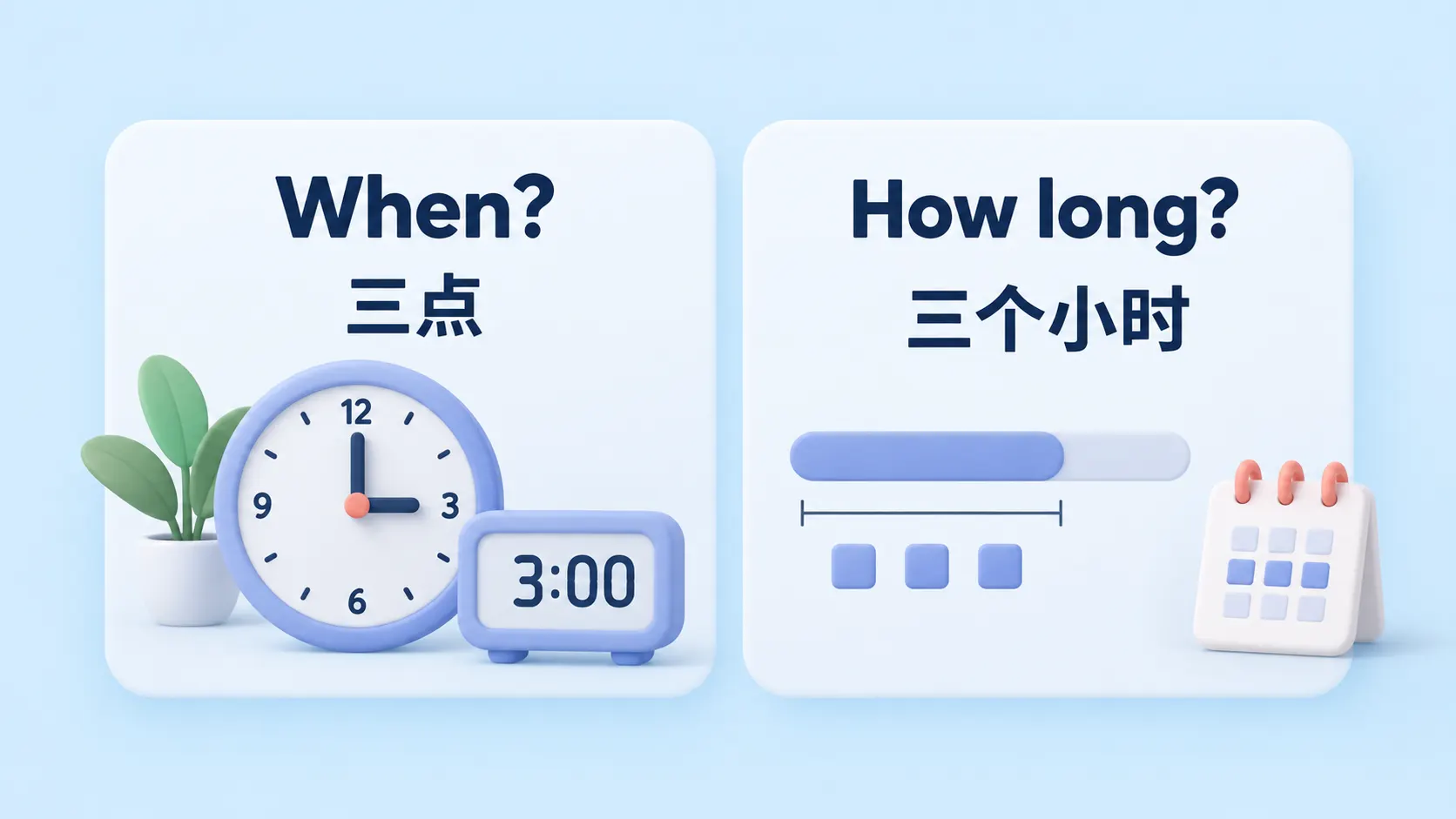
几点 asks for a time on the clock. 多长时间 or 多久 asks for a length of time.
三点
Sān diǎn
Three o’clock
三个小时
Sān ge xiǎoshí
Three hours
Compare two questions:
电影几点开始?
Diànyǐng jǐ diǎn kāishǐ?
What time does the movie start?
电影有多长?
Diànyǐng yǒu duō cháng?
How long is the movie?
A duration uses words such as 小时 or 分钟:
一个小时 (yí ge xiǎoshí): one hour.
半个小时 (bàn ge xiǎoshí): half an hour.
十五分钟 (shíwǔ fēnzhōng): fifteen minutes.
Thus, 两点半 is 2:30, while 两个半小时 (liǎng ge bàn xiǎoshí) is two and a half hours. The position of 半 and the presence of 小时 matter.
Make and adjust a plan
A:我们明天几点见面?
Wǒmen míngtiān jǐ diǎn jiànmiàn?
What time shall we meet tomorrow?
B:下午两点半,可以吗?
Xiàwǔ liǎng diǎn bàn, kěyǐ ma?
Would 2:30 in the afternoon work?
A:两点半有点早。三点可以吗?
Liǎng diǎn bàn yǒudiǎn zǎo. Sān diǎn kěyǐ ma?
2:30 is a little early. Would three work?
B:可以。我们在咖啡馆见。
Kěyǐ. Wǒmen zài kāfēiguǎn jiàn.
Sure. Let’s meet at the café.
A:好,明天下午三点见!
Hǎo, míngtiān xiàwǔ sān diǎn jiàn!
Great, see you tomorrow at three!
The final line repeats the complete agreed time. That is useful even when both speakers are fluent: a short confirmation prevents mismatched plans.
Handle approximate and exact times
三点左右
Sān diǎn zuǒyòu
Around three
三点整
Sān diǎn zhěng
Three o’clock exactly
左右 allows approximation; 整 emphasizes the exact hour. Choose the one that matches the arrangement. “Around three” is not the same promise as “three sharp.”
To ask someone to arrive earlier:
请提前十分钟到。
Qǐng tíqián shí fēnzhōng dào.
Please arrive ten minutes early.
Here, 十分钟 is a duration measured relative to the meeting time. It is not ten o’clock.
Practice
- Write 7:30 in Chinese.
- Write 2:05 using the full minute form.
- Say “tomorrow evening at eight.”
- Choose the correct expression for three hours: 三点 or 三个小时.
- Ask what time class starts: use 上课.
- Put these words in order: 我们 / 见面 / 明天 / 下午四点.
- What is the difference between 两点半 and 两个半小时?
Answers
- 七点半 (qī diǎn bàn).
- 两点零五分 (liǎng diǎn líng wǔ fēn).
- 明天晚上八点 (míngtiān wǎnshang bā diǎn).
- 三个小时 (sān ge xiǎoshí).
- 几点上课? (Jǐ diǎn shàngkè?)
- 我们明天下午四点见面。 (Wǒmen míngtiān xiàwǔ sì diǎn jiànmiàn.)
- The first is a clock time, 2:30; the second is a duration, two and a half hours.
Frequently asked questions
Can I say 二点?
You may encounter 二 in some formal numeric readings, but 两点 is the everyday form to learn for two o’clock.
Is 半点 the same as 点半?
No. Use the hour followed by 点半 for “half past”: 八点半 is 8:30.
Should I put 在 before every time?
No. Ordinary sentences such as 我三点下班 do not require 在 before 三点.
Does 了 in 现在几点了 mean past time?
No. 了 has functions beyond past-event descriptions. The question still asks the current time.
To connect clock expressions with broader time language, read Chinese tenses and time reference. Then practice arranging one real meeting: specify the day, part of day, time, and place, and repeat the final agreement.
How to Tell Time: Key Points
Keep learning: Explore Chinese Grammar Guide and Chinese Vocabulary Hub for related lessons.