Learning Chinese often raises one major question for English speakers:
“If Chinese verbs don’t change for tense, how do I know when an action happened?”
This article will guide you step by step to understand Chinese tenses like how Chinese expresses past, present, and future, why it seems different from English, and how to form clear sentences in daily conversation.
By the end of this guide, you’ll be able to express time accurately in Mandarin, even without verb conjugations.
Table of Contents
Do Chinese Verbs Have Tenses?
The short answer: No. Chinese verbs do not change to indicate past, present, or future.
Unlike English:
- English: I eat / I ate / I will eat
- Chinese: 我吃 (Wǒ chī) → can mean past, present, or future, depending on context
Why this works
Chinese relies on context and particles to indicate time. That’s why learners often feel “Chinese has no tense,” but the language still communicates time perfectly.
How to Express the Past in Chinese
To indicate past actions, Chinese uses:
- Time expressions
- Particles like 了 (le)
1. Using Time Expressions
Add time words to clarify the past:
- 昨天 (zuótiān) – yesterday
- 上周 (shàng zhōu) – last week
- 去年 (qùnián) – last year
Example:
- 我 昨天吃 苹果。
Wǒ zuótiān chī píngguǒ.
→ I ate apples yesterday.
Here, 吃 does not change. The past is clear because of 昨天.
2. Using the Particle 了 (le)
了 indicates a completed action.
Example:
- 我 吃了 苹果。
Wǒ chī le píngguǒ.
→ I ate apples.
Tips:
- 了 often comes immediately after the verb
- Combine 时间词 + 了 for clarity:
- 我 昨天吃了 苹果 (I ate apples yesterday)
How to Express the Present
The present is usually implied without any special particle.
1. Simple Present / Ongoing Actions
- 我 吃 苹果。
I eat apples / I am eating apples. - 他 学习 中文。
He studies Chinese / He is studying Chinese.
2. Adding adverbs for clarity
- 我 现在吃 苹果。
I am eating apples now. - 她 今天工作 很忙。
She is working a lot today.
Note: Time words like 现在 (now), 今天 (today) clarify the present.
How to Express the Future
Chinese often uses time expressions or modal verbs instead of changing the verb.
1. Using Future Time Expressions
- 明天 (míngtiān) – tomorrow
- 下周 (xià zhōu) – next week
- 下个月 (xià gè yuè) – next month
Example:
- 我 明天去 北京。
I will go to Beijing tomorrow.
2. Using Modal Verbs for Intent
- 会 (huì) – will / be likely to
- 要 (yào) – want to / going to
Example:
- 我 会学习 中文。
I will study Chinese. - 我 要去 商店。
I am going to go to the store.
Tips for English Speakers
- Don’t expect verb changes: Chinese communicates time with particles + time words.
- Combine strategies: Use 时间词 + 了/会/要 for precision.
- Context is king: Often, the surrounding sentence or conversation clarifies tense.
- Practice with real sentences: Memorizing examples helps more than memorizing rules.
Common Beginner Mistakes
| Mistake | Why it’s wrong | Correct way |
|---|---|---|
| Using English tense logic | Chinese verbs don’t conjugate | Use 了 / 会 / 时间词 |
| Forgetting 了 for completed actions | Sentence may sound like present | Add 了: 我吃了苹果 |
| Misplacing time words | Confuses meaning | Always put time words before the verb or at the beginning |
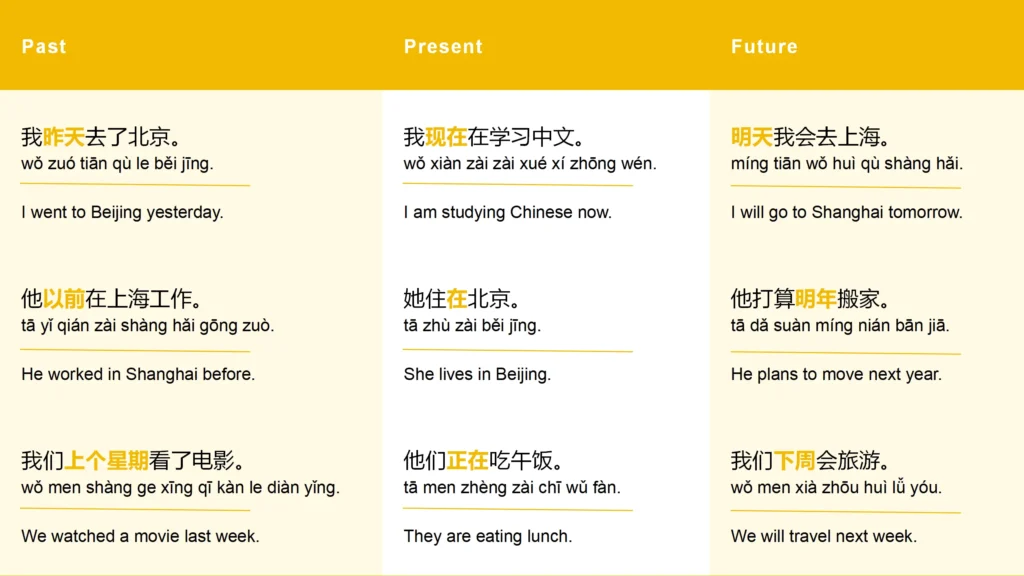
Summary Table
| Tense | How to express | Example |
|---|---|---|
| Past | 时间词 + 了 | 我昨天吃了苹果 |
| Present | Context / 时间词 | 我现在吃苹果 |
| Future | 时间词 + 会/要 | 我明天会去学校 |
Chinese tenses may look “simpler,” but mastering time words + particles allows you to express any time frame naturally.
FAQ
Does Chinese really have no tense?
Verbs don’t change form, but particles and time words indicate tense.
How do I know if a verb refers to past or future?
Look for 时间词 or particles like 了, 会, 要.
Can I use English tense logic in Chinese?
No. Use Chinese rules to avoid confusion; context and particles are essential.