Table of Contents
Learning Chinese often feels confusing at first, especially when learners try to compare it with English. One of the most common questions beginners ask is:
Does Chinese have sentence structure like English?
The short answer is: yes — and it’s simpler than you think.
In this guide, you’ll learn how Chinese sentence structure works, why Subject-Verb-Object (SVO) is the foundation of Mandarin, and how to build clear, natural sentences step by step.
What Is the Basic Chinese Sentence Structure?
The most common Chinese sentence structure follows this order:
Subject + Verb + Object (SVO)
This is the same basic structure used in English, which makes Chinese easier to start than many learners expect.
Basic Example
- 我 吃 苹果。
Wǒ chī píngguǒ.
→ I eat apples.
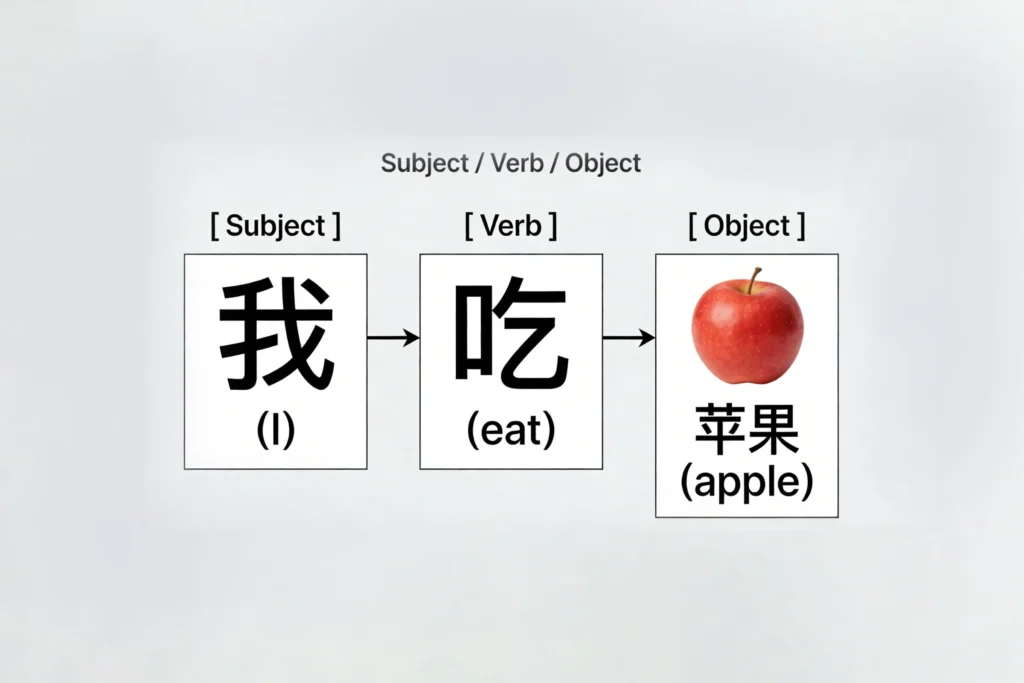
| Element | Chinese | Meaning |
|---|---|---|
| Subject | 我 | I |
| Verb | 吃 | eat |
| Object | 苹果 | apples |
No verb conjugation.
No plural forms.
No articles like “a” or “the”.
This simplicity is one of the biggest advantages of learning Chinese.
Why Chinese Sentence Structure Feels Different
If Chinese uses SVO like English, why does it still feel hard?
Because Chinese relies more on word order than grammar changes.
- Verbs do not change for tense
- Nouns do not change for plural
- Meaning depends on position and context
That means sentence structure is critical.
Subject in Chinese Sentences
The subject comes first and answers who or what performs the action.
Common Subjects
- Pronouns: 我 (I), 你 (you), 他/她 (he/she)
- Nouns: 学生 (student), 手机 (phone)
- Phrases: 学中文的人 (people who learn Chinese)
Example
- 他 学 中文。
Tā xué Zhōngwén.
→ He studies Chinese.
Verb Placement in Chinese
The verb always comes after the subject and before the object.
Chinese verbs:
- Do not change with tense
- Do not change with subject
Example
- 我 喜欢 咖啡。
I like coffee. - 她 工作 很忙。
She works very busy. (natural in Chinese)
Object Position in Chinese
The object usually follows the verb directly.
Example
- 我 买 书。
I buy books. - 他们 用 手机。
They use phones.
If you change the order, the sentence becomes incorrect or unnatural.
Adding Time and Place (Very Important)
Chinese sentences often follow this extended structure:
Time + Place + Subject + Verb + Object
Example
- 今天 在 家里 我 学 中文。
Today at home I study Chinese.
This is correct Chinese, even though it feels reversed to English learners.
Common Beginner Mistakes with Chinese Sentence Structure
❌ Copying English Grammar Directly
- Incorrect: 我 是 吃 苹果
- Correct: 我 吃 苹果
❌ Overusing “to be”
Chinese often does not need 是 (to be).
How Chinese Sentence Structure Helps You Learn Faster
Once you master SVO:
- Grammar becomes predictable
- You can form sentences early
- Vocabulary learning becomes easier
That’s why sentence structure should be your first foundation.
Summary: Chinese Sentence Structure Made Simple
- Chinese follows Subject + Verb + Object
- Word order is more important than grammar changes
- No tense, no plural, no conjugation
- Context and position carry meaning
Master this, and Chinese will feel far less intimidating.
Frequently Asked Questions
Does Chinese always use SVO?
Most everyday sentences do, but there are special structures like 把 and 被, which you’ll learn later.
Is Chinese sentence structure easier than English?
In many ways, yes — fewer grammar rules, but stricter word order.
Go to the Learning Chinese Hub homepage and continue your Mandarin journey.