
Home › Vocabulary
Chinese Vocabulary for Everyday Life
Learn useful Chinese words, understand how they work, and choose the right words for everyday situations.
Quick Answers
Five basics to know before you start.

Is a character the same as a word?
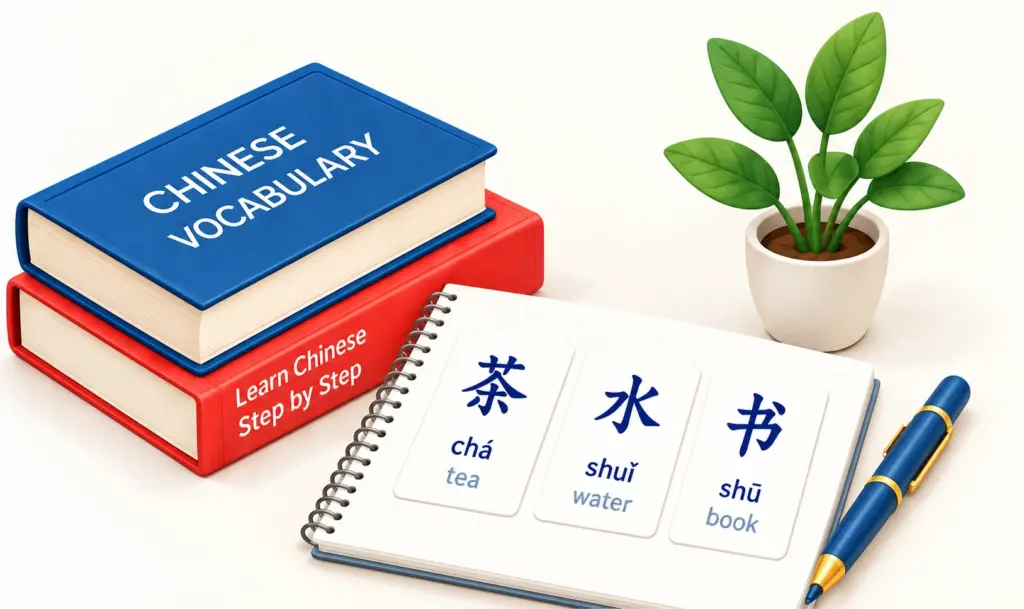
Not always. A word may contain one character or several: 书 and 学生 are both words.

What does pinyin show?
Latin letters and tone marks show Mandarin pronunciation.

Are tones part of a word?
Yes. Learn the pronunciation and tones together.

Why learn words in phrases?
Phrases show natural partners, such as 喝水 for “drink water.”

Can one character appear in many words?
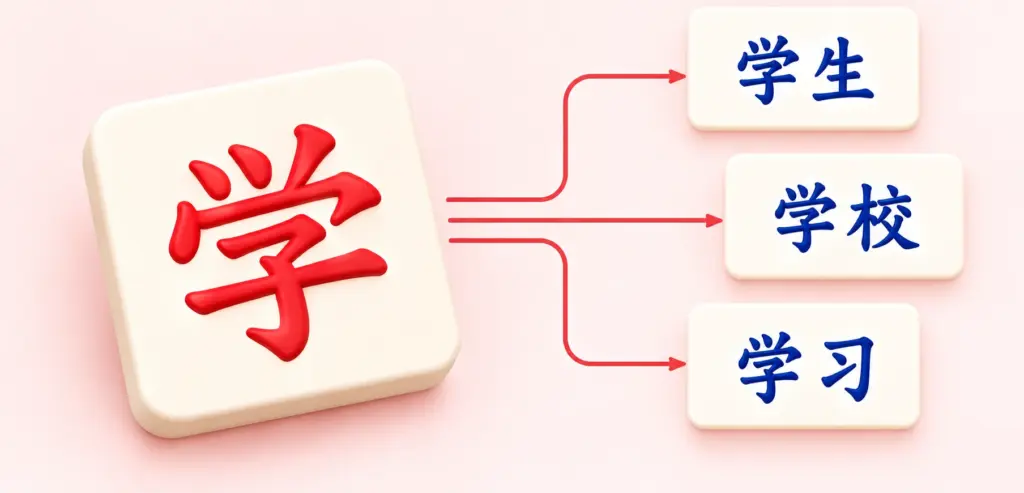
Yes. 学 appears in 学生, 学校, and 学习. Learn each whole word.
Your Chinese Vocabulary Learning Path
Use these six steps with any new word.






One Word, Six Steps: 水
- Meaning: 水 means water. Picture a glass of water.
- Sound: 水 — shuǐ. Note the third-tone mark.
- Phrase: 喝水 — hē shuǐ — drink water.
- Sentence: 我想喝水。— Wǒ xiǎng hē shuǐ. — I want to drink water.
- Review: Cover the word and recall its meaning, pronunciation, and a phrase.
- Use: 请给我一杯水。— Qǐng gěi wǒ yì bēi shuǐ. — Please give me a glass of water.
Essential Chinese Vocabulary Guides
Build a foundation with words that work across many situations.




Chinese Numbers
Useful number forms: 一、二、三、十、百. Use numbers to count, read prices, and say phone numbers. For a number with a noun, learn its measure word too.
Time & Dates
Start with 今天、明天、昨天、点、分、月、号. Use time words to make plans and dates to talk about birthdays and appointments.
Everyday Verbs
吃 — chī — eat; 喝 — hē — drink; 去 — qù — go; 做 — zuò — do or make. Learn each verb in a phrase: 吃饭、喝水、去学校、做作业.
Describing Words
大 — dà — big; 小 — xiǎo — small; 热 — rè — hot; 冷 — lěng — cold. Pair them with everyday examples rather than treating all adjectives as interchangeable.
Explore Chinese Vocabulary by Topic
Find words for the situation you want to handle.

People & Relationships
Talk about family, interests, and the people around you.

Food & Drinks
Choose a meal, order a drink, and describe what you like.

Shopping & Services
Ask about sizes, choices, and everyday services.

Travel & Places
Find your way, use public transport, and check into a hotel.

Work & Study
Talk about tasks, classes, and learning.

Home & Daily Life
Describe your routines, your home, and the world outside.
Featured Vocabulary Topic
See how a familiar character connects useful words.
One Character, Many Words
Recognizing a familiar character can help you notice connections between words. Start with 学, then learn each whole word through its meaning and an example.
学生
student
学校
school
学习
study; learn
A familiar character is a clue, not a complete definition. Check the meaning and pronunciation of the whole word.
Explore the 学 Word Family in Context
她是学生。— Tā shì xuésheng. — She is a student.
学校很大。— Xuéxiào hěn dà. — The school is big.
我学习中文。— Wǒ xuéxí Zhōngwén. — I study Chinese.
Frequently Asked Questions
Should I learn simplified or traditional characters?
Choose the writing system used by the people and materials you expect to read most often. Simplified characters are widely used in mainland China, while traditional characters are common in Taiwan and Hong Kong. You can learn to recognize the other system gradually.
Is spoken vocabulary different from written vocabulary?
There is substantial overlap, but some words are more common in conversation and others in formal writing. Look for usage notes and examples from the kind of Chinese you want to use.
Should I study vocabulary by HSK level or by topic?
Use level-based lists when working toward an exam or a structured course. Topic-based study helps with immediate needs such as ordering food or traveling. You can combine both without treating every word as equally urgent.
How can I choose a useful vocabulary resource?
Look for clear meanings, pinyin with tones, natural example sentences, and usage notes. Reliable audio is useful for pronunciation practice. Choose materials suited to your level and goals.
When should I use a Chinese-only dictionary?
Try one when you can understand enough of the definitions and examples to make it useful. You can keep a bilingual dictionary alongside it and compare explanations when a meaning is unclear.
Do regional differences affect vocabulary?
Yes. Some everyday terms and preferred expressions vary across Mandarin-speaking communities. Notice the region associated with a resource, especially when learning for a particular place.
Common Chinese Vocabulary Mistakes
Notice the choices that make a word fit its context.
Relying on One English Translation
An English gloss is a starting point. Check examples to understand the word’s meaning and range of use.
Using Unnatural Word Combinations
Learn common partners together: 打电话 means “make a phone call.”
Treating Similar Words as Identical
知道 and 认识 are not interchangeable in every sentence.
Mixing Formal and Conversational Words
Check the setting. 购买 often sounds more formal than 买.
Guessing from Characters Alone
小心 means “be careful,” not “small heart.” Check the whole word.
Keep Learning
Compare a pair of words and make a more precise choice.




简单 vs 容易
简单 often describes something uncomplicated; 容易 describes something easy to do or likely to happen. 这个问题很简单。— This question is simple. 这件事很容易做。— This is easy to do.
方便 vs 便利
方便 is common for everyday convenience and personal availability. 便利 often appears in descriptions of access, facilities, or helpful services. Check the phrase and context.
方法 vs 办法
方法 commonly describes a method or procedure. 办法 often refers to a way to handle a problem. 学习方法 — a study method; 想办法 — think of a way.
经验 vs 经历
经验 describes knowledge or skill gained through experience. 经历 can describe things someone has been through, or mean to experience an event. 工作经验 — work experience; 一段难忘的经历 — an unforgettable experience.
Find Words for Your Next Conversation
Choose a topic that fits your day and start with a few useful words.